

Chess Openings for White: 1. e4 or 1. d4?
Chess openings for white, split by first move. Pick 1. e4 or 1. d4 in one question, then drill the exact lines free, move by move.
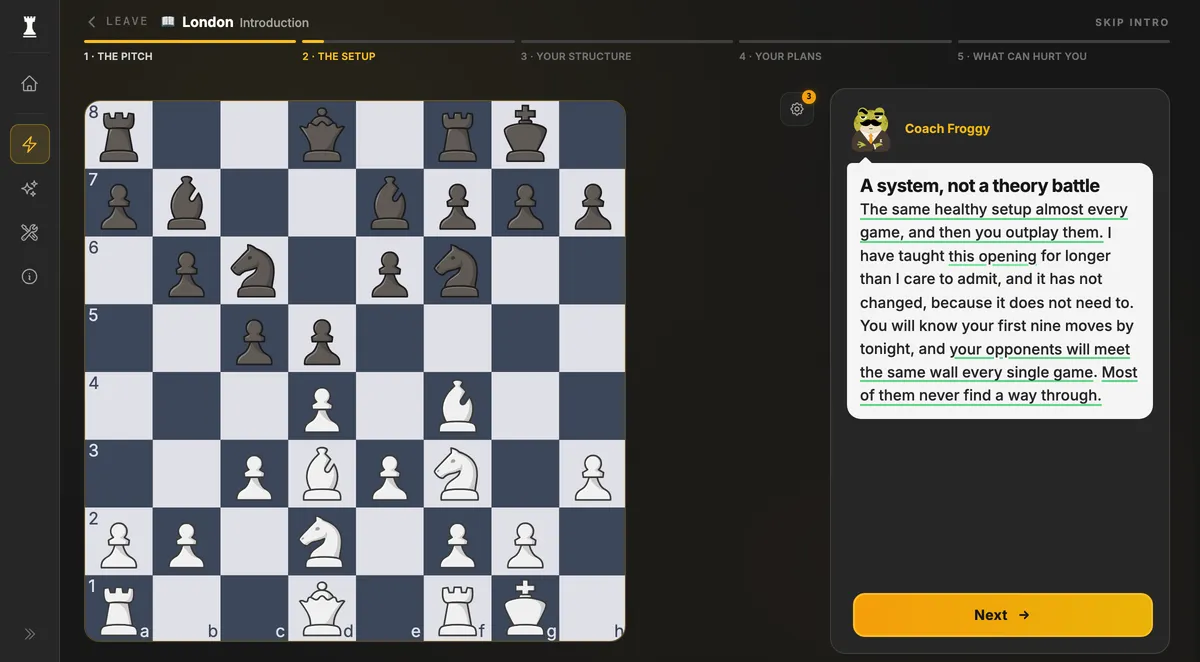
Choosing chess openings for white is really one decision, made on move one, and everything after it is detail. Play 1. e4 and you owe yourself three separate answers to three unrelated defenses. Play 1. d4 and you can get away with one setup for years. Here is that choice settled with real numbers from 1.83 billion club games, and then the exact lines for whichever side you land on.
Build your White repertoire move by move
Every opening linked in this guide has a free course on Chessigma. You play White, the board answers with what club opponents actually pick, and a coach explains the point of the key moves. The first five lines of every course are free, no account needed.
Open the chess openings trainer1. e4 or 1. d4: one question picks your whole repertoire
The scores are almost identical. In the 1000 to 1600 band, 1. d4 scores 52.7% for White and 1. e4 scores 51.9%, across 1.83 billion games between them. Anyone who tells you one first move is objectively better for a club player is arguing about 0.8 of a percentage point. One note on reading every "vs baseline" number below: each line is measured at the position its moves reach, and compared against White's unconditional score after that first move. So it answers "when I get this position, how does it go?", not "is this objectively best", and part of any gap is which opponents choose to enter the line at all.
The difference that actually matters is how much you have to learn, and that is enormous. After 1. e4, Black splits your games six ways, and the three that cost White the most ground are the three that need the most preparation:
| After 1. e4, Black plays | Moves | White scores | vs baseline | Games |
|---|---|---|---|---|
| 1... e5, the Open Game | 1. e4 e5 | 53.0% | +1.1 | 743,020,896 |
| The Sicilian Defense | 1. e4 c5 | 49.2% | -2.7 | 164,111,341 |
| The Scandinavian Defense | 1. e4 d5 | 51.7% | -0.2 | 130,152,916 |
| The French Defense | 1. e4 e6 | 50.1% | -1.8 | 106,595,409 |
| The Caro-Kann Defense | 1. e4 c6 | 49.2% | -2.7 | 72,838,675 |
| The Pirc Defense | 1. e4 d6 | 51.9% | ±0.0 | 37,989,122 |
Read that table again, because it is the whole article. White does fine against 1... e5 at 53.0%, and fine against the Scandinavian and the Pirc. Against the Sicilian and the Caro-Kann, White scores 2.7 points below the 1. e4 average, and those two are roughly one in six of all your 1. e4 games (237 million of 1.36 billion). The French costs another 1.8. The 1. e4 player who only studies 1... e5 lines has prepared for the games they were already winning.
The decision, stated once: pick 1. e4 if you want open positions and are willing to prepare three defenses. Pick 1. d4 if you want one setup you can play on autopilot for a year while you spend your study time on tactics. Both are correct. Doing the first one badly is what costs rating.
What White is actually trying to do out of the opening
White's advantage is one move of time. Every opening below is a different way of spending it, and every bad opening is a way of wasting it. The four things you are buying:
- 1. A pawn in the centre, kept there. e4 or d4 on move one, and a second centre pawn when you can support it. Space is what makes your pieces better than your opponent's.
- 2. A new piece every single move. Knights before bishops, bishops before the queen. If you have moved one piece twice by move six without being forced to, you have handed back the move you started with.
- 3. A king that is already safe. Castle by move ten. Openings that delay it (gambits, early queen sorties) score well against unprepared opponents and stop working the moment someone punishes them.
- 4. One target to play against. A weak square, an open file, a backward pawn, the f7 square. The Scotch gives you an open centre; the London gives you the kingside; the English gives you the queenside. Know which one your opening hands you.
Notice what is not on that list: memorising fifteen moves of theory. Nothing below asks you to.
The 1. e4 repertoire, ranked by what it actually scores
All of these are answers to 1... e5, the reply you meet most. Compare each against White's 51.9% baseline after 1. e4, not against 50%, or you will rate every one of them as good.
| Opening | Moves | White scores | vs baseline | Games |
|---|---|---|---|---|
| King's Gambit | 1. e4 e5 2. f4 | 55.6% | +3.7 | 30,246,913 |
| Scotch Game | 1. e4 e5 2. Nf3 Nc6 3. d4 | 55.5% | +3.6 | 48,036,621 |
| Ruy Lopez | 1. e4 e5 2. Nf3 Nc6 3. Bb5 | 53.5% | +1.6 | 60,928,295 |
| Bishop's Opening | 1. e4 e5 2. Bc4 | 53.2% | +1.3 | 84,620,878 |
| Italian Game | 1. e4 e5 2. Nf3 Nc6 3. Bc4 | 52.9% | +1.0 | 130,831,377 |
| Vienna Game | 1. e4 e5 2. Nc3 | 52.4% | +0.5 | 42,061,193 |
| Four Knights Game | 1. e4 e5 2. Nf3 Nc6 3. Nc3 Nf6 | 51.4% | -0.5 | 33,926,321 |
The Scotch Game is the pick, at 55.5%. 3. d4 hits the e5 pawn a second time, Black cannot hold it, and the centre opens on move three. That is 2.6 points better than the Italian Game, and it keeps the game open instead of letting it drift into the slow manoeuvring where club players run out of ideas. The one line to know: after 3... exd4 4. Nxd4 Bc5, the natural 5. Nxc6 runs into 5... Qf6, hitting the knight and looking down the f-file. It is fine for White, you just need the reply ready: 6. Qd2 or 6. Qf3. If you would rather skip it, 5. Be3 holds everything together.
The Italian Game is the most played opening in the world and it scores +1.0. That is not a reason to avoid it. It is a reason to know that its popularity, not its results, is why every beginner list puts it first. It earns its place if you like the Fried Liver and the Greek Gift patterns that come out of it, and it is the safest introduction to open positions there is.
The Vienna Game at +0.5 is the trap specialist, and the number understates it. 2. Nc3 followed by Bc4 sets up the Qg4 lunge against the copycat 3... Bc5, which is exactly what an unprepared club opponent plays and exactly where the Chessigma course starts. Take it if you enjoy winning games in fifteen moves. Do not take it if you want a system you never have to think about.
Two more worth naming. The Ruy Lopez scores 53.5% and is the most respected opening on the list, at the cost of real theory. The King's Gambit scores 55.6%, the highest of any of them, and it is a genuine gambit: that edge comes from opponents who do not know the refutation, so it shrinks as you climb. If you came here looking for the most aggressive chess openings for White, it is that one and the Smith-Morra in the anti-Sicilian table below. Play either knowing what you bought.
The 1. d4 repertoire: the London System, and one setup for everything
| Opening | Moves | White scores | vs baseline | Games |
|---|---|---|---|---|
| Queen's Gambit | 1. d4 d5 2. c4 | 55.3% | +2.6 | 79,123,313 |
| London System | 1. d4 d5 2. Bf4 | 54.4% | +1.7 | 53,293,951 |
The London System scores 54.4%, which is 1.7 points above the 1. d4 baseline, over 53.3 million games, measured at the accelerated 2. Bf4 move order against 1... d5. The Queen's Gambit scores higher, at 55.3%, and it is the honest recommendation for anyone willing to learn a real body of theory: after 2. c4 you have to answer the Slav, the Queen's Gambit Declined, the Accepted and half a dozen Indian defenses. The London is the one that costs almost nothing.
- The whole system, in eight moves: d4, Bf4, e3, c3, Nf3, Nbd2, Bd3, O-O. Learn the order once and you have a White repertoire.
- Get the bishop out first. Bf4 before e3, always, or you have locked your best piece behind its own pawn. This is the single most common London mistake.
- Then pick a wing. Ne5 with f4 for a kingside attack, or dxc5 and queenside expansion if Black plays an early ...c5.
- Two replies to prepare: ...Qb6, hitting the b2 pawn your bishop stopped guarding, and an early ...Bf5, where you abandon the setup and strike with c4 instead.
Beyond 1. e4 and 1. d4: the English Opening
The English Opening, 1. c4, scores 52.9% over 47.9 million games, 0.9 points above White's overall average. It claims the centre from the side instead of occupying it, which takes your opponent out of their preparation on move one, and it transposes into a lot of the same structures as 1. d4 if you want it to.
- What you get: a fight for d5 from the wing. c4, Nc3, g3, Bg2, Nf3, castle, and the bishop stares down the long diagonal at Black's queenside.
- Why it takes people out of the book: almost nobody below 1600 has prepared a reply to 1. c4, so you reach a position you have seen more often than they have.
- The cost: Black can answer four completely different ways (1... e5, 1... c5, 1... Nf6, 1... e6) and you need a plan rather than a line for each.
- Take it third, not first. The English rewards understanding pawn structures more than memorising moves, which is a fine thing to grow into and a hard place to start.
What to play against the Sicilian, the Caro-Kann and the French
This is the section the 1. e4 player actually needs, and the one every beginner guide skips. Three defenses, ranked by what White really scores against each way of meeting them. Two warnings before the tables. The most popular choice is the worst against the French and the second worst against the Caro-Kann, so popularity is not your guide. And the top scorer against both the Caro-Kann and the French has a much smaller sample than the rest of its column, so treat those two as promising rather than proven.
Against the Sicilian, 1... c5
| How White meets it | Moves | White scores | vs baseline | Games |
|---|---|---|---|---|
| Smith-Morra Gambit | 1. e4 c5 2. d4 cxd4 3. c3 | 52.6% | +0.7 | 2,672,592 |
| Alapin | 1. e4 c5 2. c3 | 51.7% | -0.2 | 7,012,537 |
| Rossolimo | 1. e4 c5 2. Nf3 Nc6 3. Bb5 | 51.3% | -0.6 | 4,685,067 |
| Grand Prix Attack | 1. e4 c5 2. Nc3 Nc6 3. f4 | 51.2% | -0.7 | 672,419 |
| Open Sicilian | 1. e4 c5 2. Nf3 d6 3. d4 | 50.9% | -1.0 | 9,638,025 |
| Closed Sicilian | 1. e4 c5 2. Nc3 | 48.7% | -3.2 | 12,014,031 |
Nothing beats the Sicilian. Averaged across everything White tries it scores 49.2% against 1... c5, 2.7 points below its own baseline, and the spread below separates a bad answer from a passable one rather than from a winning one. The goal is damage control plus a position you understand. The Alapin, 2. c3, is the sane club answer: 51.7%, seven million games, and one idea: build the big centre with d4, and when Black hits it with 2... d5 take with exd5 and gain time on the queen. The Smith-Morra scores highest at 52.6% and it is a gambit, so the same caveat as the King's Gambit applies. Avoid the Closed Sicilian: 48.7%, the worst number in this article, 3.2 points below baseline over twelve million games. It looks safe and it concedes ground move by move. Note that the Grand Prix row above sits inside this one: 2. Nc3 is where both begin, and adding f4 is worth two and a half points.
Against the Caro-Kann, 1... c6
| How White meets it | Moves | White scores | vs baseline | Games |
|---|---|---|---|---|
| Panov Attack | 1. e4 c6 2. d4 d5 3. exd5 cxd5 4. c4 | 54.0% | +2.1 | 786,141 |
| Main line, 3. Nc3 | 1. e4 c6 2. d4 d5 3. Nc3 | 52.5% | +0.6 | 5,479,264 |
| Fantasy, 3. f3 | 1. e4 c6 2. d4 d5 3. f3 | 51.9% | ±0.0 | 892,679 |
| Advance, 3. e5 | 1. e4 c6 2. d4 d5 3. e5 | 50.3% | -1.6 | 14,275,869 |
| Exchange, 3. exd5 | 1. e4 c6 2. d4 d5 3. exd5 | 49.9% | -2.0 | 6,211,227 |
Here the data disagrees with the crowd, and we will say so about our own course. The Advance, 3. e5, is by far the most played choice at 14.3 million games, and it scores 50.3%, worse than the quiet 3. Nc3 at 52.5%. If you want the best club-level result from a line with a real sample, play 3. Nc3. If you want the sharp version with a concrete attacking plan, Chessigma's Advance Variation course teaches the 4. h4 Bayonet, the bishop trap and the king hunt, which is where the Advance's wins come from when they come. The Panov's 54.0% is the best number in the column on a much smaller sample.
Against the French, 1... e6
| How White meets it | Moves | White scores | vs baseline | Games |
|---|---|---|---|---|
| Tarrasch, 3. Nd2 | 1. e4 e6 2. d4 d5 3. Nd2 | 54.6% | +2.7 | 552,107 |
| Main line, 3. Nc3 | 1. e4 e6 2. d4 d5 3. Nc3 | 51.6% | -0.3 | 5,382,604 |
| Exchange, 3. exd5 | 1. e4 e6 2. d4 d5 3. exd5 | 51.4% | -0.5 | 7,062,244 |
| Advance, 3. e5 | 1. e4 e6 2. d4 d5 3. e5 | 48.9% | -3.0 | 18,481,705 |
The same shape again: the Advance, 3. e5, is the popular one at 18.5 million games and the worst one at 48.9%, three points below baseline. The Tarrasch, 3. Nd2, tops the column at 54.6% on half a million games. The reliable middle is 3. Nc3 at 51.6%, essentially baseline, and it is the move that keeps the most options open, at the price of letting Black choose between the Winawer, the Classical and the Rubinstein. If you want to know what you are up against from the other side, Chessigma teaches the French from Black's point of view.
How to tell whether your repertoire survives contact
Every number on this page is an average over millions of players. Yours is the only one that decides your rating, and you already have the data: import ten of your own games and look at the point where the game stops being theory. That is where your repertoire actually ends, whatever you think you know.
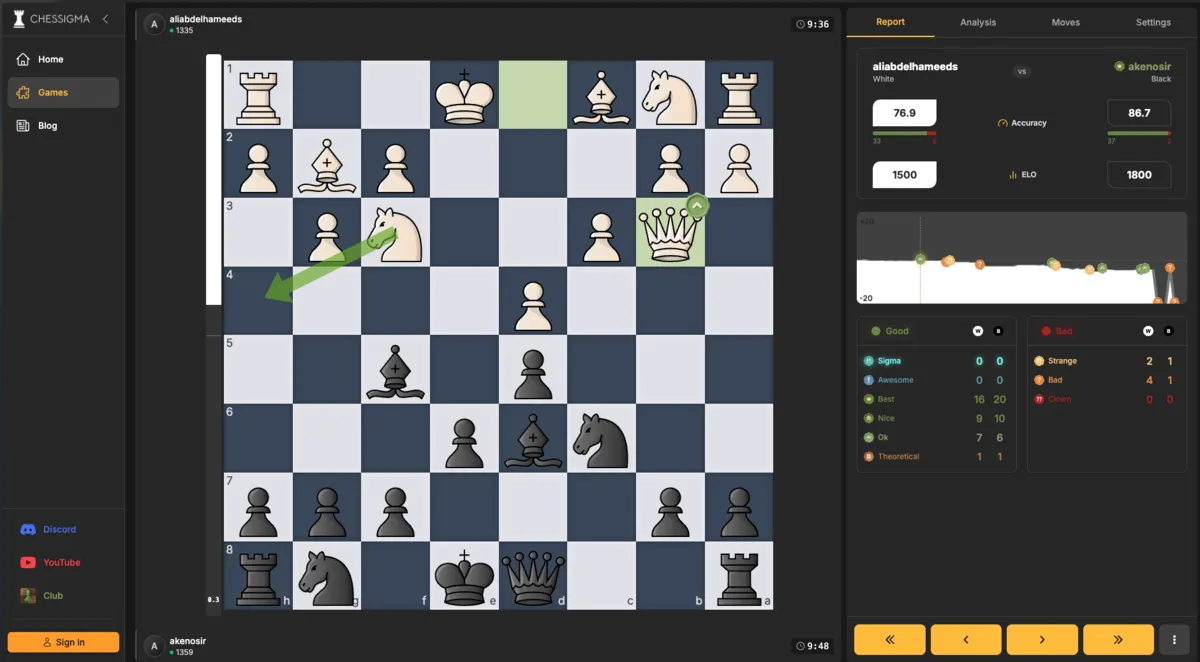
The review counts your theory moves, grades every move from Sigma down to Clown, and reports accuracy and centipawn loss for both sides. It is free and unlimited, and the engine runs in your browser rather than on a queue. If the theory count stops on move four in most of your games, the fix is not a new opening. It is drilling the one you already picked.
Learn the whole London in an hour
One setup, every Black reply club players actually pick, and a coach on every move. The cheapest White repertoire in chess, drilled until it is automatic.
Train the London System freeFrequently asked questions
What are the best chess openings for White?
Measured against what White actually scores in the 1000 to 1600 band, the Scotch Game (55.5%) leads the 1. e4 openings and the London System (54.4%) leads the 1. d4 setups, with the Queen's Gambit at 55.3% if you will learn more theory. Compare each against White's own baseline rather than against 50%, because White already scores 51.9% after 1. e4 and 52.7% after 1. d4 before choosing anything. The honest answer to the question is that the first move matters more than the opening: pick 1. e4 or 1. d4 first, then take the highest-scoring opening on that side and drill it.
Is 1. e4 or 1. d4 better for White?
Neither, by score: 52.7% for White after 1. d4 against 51.9% after 1. e4, and 0.8 of a point is not a reason to choose. Choose on workload, which is where they differ enormously. 1. e4 splits your games six ways and three of those splits cost White ground, so a real 1. e4 repertoire is four separate bodies of knowledge: an answer to 1... e5, one to the Sicilian, one to the Caro-Kann and one to the French. 1. d4 lets you play one setup, the London, against most of what you meet, at the cost of a quieter game. Pick 1. e4 if you will do the preparation, 1. d4 if you would rather spend that time on tactics.
What are the three golden rules of the chess opening?
Take the centre with a pawn, develop a new piece every move with knights and bishops before the queen, and castle by move ten. That is the whole thing. Every opening in this article is one specific way to do those three things quickly, which is why you can play any of them well after twenty minutes of study and why none of them saves you if you skip the third rule.
What are the best first four moves in chess?
For White, the highest-scoring sequences a club player can rely on all look the same: a centre pawn, a knight, a bishop, then castle. Concretely 1. e4 e5 2. Nf3 Nc6 3. d4, the Scotch, scores 55.5% for White, and 1. d4 d5 2. Bf4, the London, scores 54.4% at that position. Neither brings the queen out and neither moves a piece twice. One exception is worth knowing: the King's Gambit scores 55.6% precisely by breaking the rules, and that edge comes from opponents who do not know the refutation rather than from the position itself.
Do I need a different opening against every Black defense?
As White after 1. e4, yes: 1... e5, 1... c5, 1... c6 and 1... e6 lead to four unrelated positions and you need a plan for each. After 1. d4 you do not, and that is the London System's whole argument. The same setup (d4, Bf4, e3, c3, Nf3, Nbd2, Bd3, castle) works against a huge share of what Black plays, so you spend your study time on plans instead of move orders. It scores 54.4% for White, 1.7 points above the 1. d4 average.
Method for every number here: the Lichess opening explorer, blitz and rapid, rating buckets 1000, 1200 and 1400 (the buckets are lower bounds, so the band runs to 1599), pulled 13 August 2026. Each line is measured at the position its moves reach, and White's score is (wins + draws/2) / games. The explorer is public, so every row is checkable.
Playing Black too? The same data ranks the best chess openings for beginners on both sides of the board, including the two defenses that score worst.