

Chess Notation: The Complete Guide to Algebraic Notation
Learn chess notation in 5 minutes. Complete guide to algebraic notation with examples, special moves, and how to read and write chess moves.
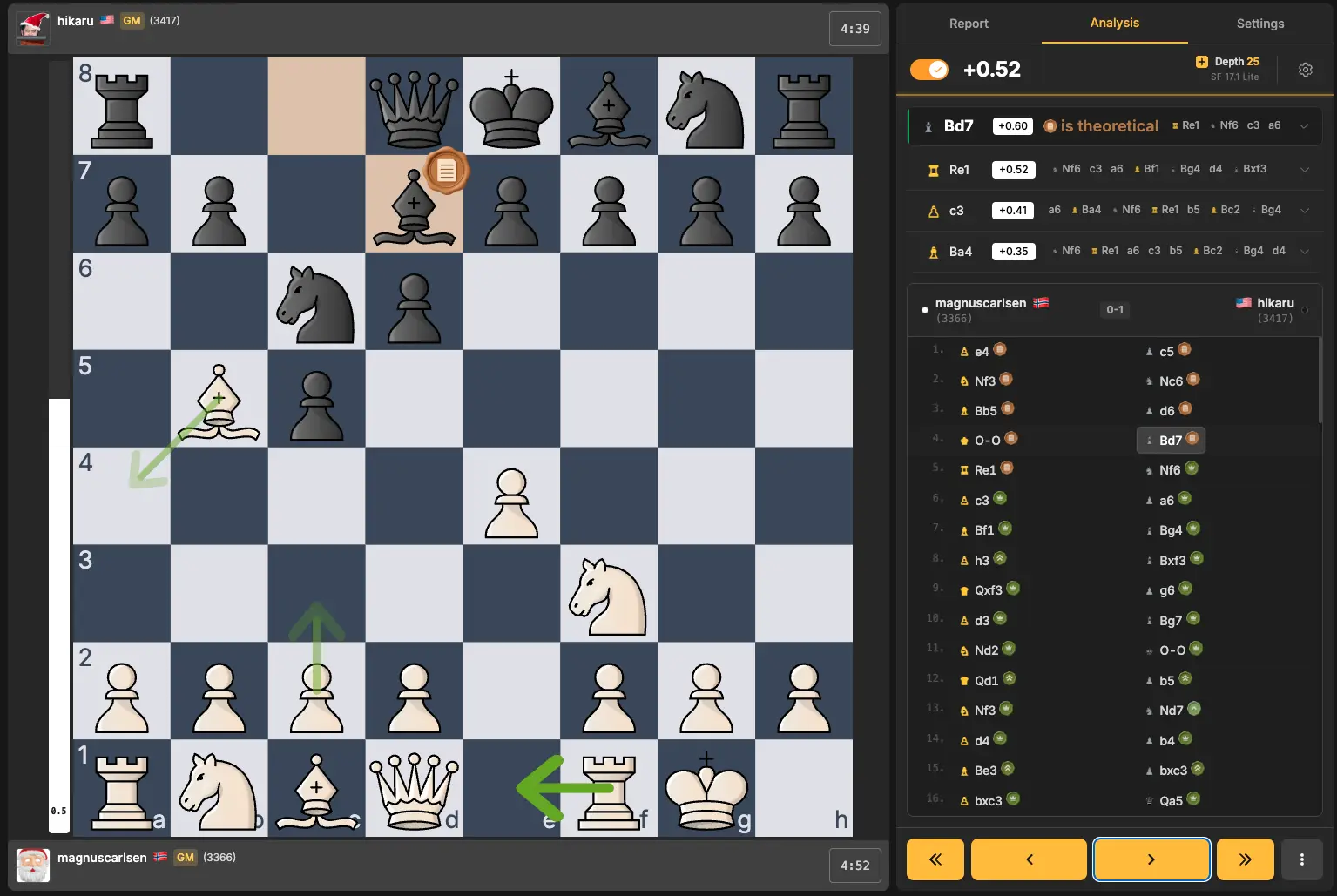
Chess notation is the standard way to record and communicate chess moves. The most widely used system is algebraic chess notation, adopted by FIDE as the official notation for all chess publications and tournaments since 1997. Whether you're reviewing a grandmaster game, analyzing your own play on Chessigma, or learning from a chess book, understanding algebraic notation is essential. This guide teaches you everything you need to know, from basic piece symbols to recording complex moves, in under 5 minutes.
What is Chess Notation?
Chess notation is a written language for recording chess moves. Every competitive game played under FIDE rules must be recorded in algebraic notation. Beyond tournaments, notation is how chess knowledge is shared: opening theory, annotated games, puzzle solutions, and engine analysis all use it.
Before algebraic notation became the standard, several systems existed. FIDE officially adopted algebraic notation chess as the universal standard in 1997, replacing older systems like descriptive notation. Today, every chess website, book, and engine uses algebraic notation.
How Algebraic Chess Notation Works
The Board Coordinates
The chessboard is an 8×8 grid. Columns are called files and labeled a through h from left to right (from White's perspective). Rows are called ranks and numbered 1 through 8 from bottom to top. Every square has a unique name combining its file letter and rank number, for example e4, d7, or a1.
Piece Symbols
Each piece has a single-letter abbreviation. Pawns have no letter, so you just write the destination square.
| Piece | Symbol | Example |
|---|---|---|
| King | K | Ke2 |
| Queen | Q | Qd5 |
| Rook | R | Ra1 |
| Bishop | B | Bc4 |
| Knight | N | Nf3 |
| Pawn | (none) | e4 |
Writing Moves
- Basic move: piece letter + destination square. Nf3 = knight moves to f3.
- Pawn move: destination only. e4 = pawn moves to e4.
- Capture: piece + x + destination. Bxf7 = bishop captures on f7. For pawns: exd5 = e-pawn captures on d5.
- Disambiguation: when two identical pieces can reach the same square, add the file or rank of the moving piece. Rae1 = the rook on the a-file moves to e1. R1e1 = the rook on rank 1 moves to e1.
Special Moves
- Kingside castling: O-O
- Queenside castling: O-O-O
- En passant: written as a normal pawn capture (e.g., exd6)
- Pawn promotion: e8=Q (pawn reaches e8 and promotes to a queen)
Game Annotations
- Check: + (e.g., Bb5+)
- Checkmate: # (e.g., Qf7#)
- Good move: !
- Brilliant move: !!
- Mistake: ?
- Blunder: ??
Reading a Full Chess Game in Notation
Let's walk through Scholar's Mate, one of the fastest checkmates in chess, to see algebraic notation in action.
Scholar's Mate
1. e4 e5
White pushes the king's pawn two squares to e4. Black mirrors with e5.
2. Bc4 Nc6
White develops the bishop to c4, aiming at f7 (Black's weakest square). Black develops the knight to c6, defending the e5 pawn.
3. Qh5 Nf6??
White brings the queen to h5, threatening both e5 and f7. Black plays Nf6, a natural developing move that attacks the queen, but it's a blunder (??) because it doesn't defend f7.
4. Qxf7#
Queen captures the pawn on f7 with checkmate. The king is attacked by both the queen and bishop, with no escape square. Game over.
Finding the Best Move in Algebraic Chess Notation
One common challenge, whether in a chess puzzle, a brain game, or a training exercise, is identifying and writing the best move in algebraic chess notation. The "best move" is the objectively strongest move in a given position, determined by a chess engine like Stockfish.
Here are a few examples of typical "best move" scenarios:
- Back-rank mate: Rd8# (the rook delivers checkmate on the back rank).
- Knight fork: Nxe6+ (the knight captures on e6 with check, forking king and queen).
- Queen sacrifice: Qxh7+ (the queen sacrifices herself to open a mating attack).
When looking for the best move, check for checks, captures, and threats first, because these are the most common strongest moves in tactical positions. Chessigma's free analysis tool evaluates every move in your games using Stockfish and shows the best alternative in algebraic notation, so you can see exactly where you went wrong and what the engine recommended.
Other Chess Notation Systems
Algebraic notation is the universal standard, but you may encounter other systems:
- Descriptive notation: the older system used in English-language chess books before the 1980s. Instead of e4, you'd write P-K4 (pawn to king 4). Ambiguous and rarely used today.
- FEN (Forsyth-Edwards Notation): encodes an entire board position in a single line of text. Used by chess engines and software to store and share positions. Example: rnbqkbnr/pppppppp/8/8/4P3/8/PPPP1PPP/RNBQKBNR
- PGN (Portable Game Notation): the standard file format for recording complete chess games, including metadata (players, date, result) and the full move list in algebraic notation. Chessigma accepts PGN imports for instant game analysis.
Chess Notation Cheat Sheet
Bookmark this quick-reference table:
| What | How to Write It | Example |
|---|---|---|
| Pawn move | destination square | e4 |
| Piece move | Piece + destination | Nf3 |
| Capture | Piece + x + destination | Bxe5 |
| Kingside castle | O-O | O-O |
| Queenside castle | O-O-O | O-O-O |
| Promotion | square = Piece | e8=Q |
| Check | move + | Bb5+ |
| Checkmate | move # | Qf7# |
Frequently Asked Questions
What is algebraic chess notation?
Algebraic chess notation is the standard system for writing chess moves. It uses a letter for the piece (K, Q, R, B, N) followed by the destination square's coordinates (a-h for files, 1-8 for ranks). Pawns use only the destination square. FIDE adopted it as the official notation in 1997.
How do you write a pawn move in chess notation?
Write only the destination square. For example, e4 means a pawn moves to e4. For pawn captures, include the file the pawn came from: exd5 means the pawn on the e-file captures on d5.
What does O-O mean in chess?
O-O means kingside castling: the king moves two squares toward the h-file rook, and the rook jumps to the other side. O-O-O is queenside castling, where the king moves two squares toward the a-file rook.
How do you find the best move in algebraic chess notation?
Use a chess engine like Stockfish to analyze the position. The engine evaluates every legal move and identifies the objectively strongest one, expressed in standard algebraic notation. Tools like Chessigma run Stockfish analysis for free and show the best move for every position.
What is the difference between algebraic and descriptive notation?
Algebraic notation uses a fixed coordinate grid (files a-h, ranks 1-8) so every square has one universal name. Descriptive notation uses piece-relative positions from each player's perspective (e.g., P-K4 instead of e4), making it ambiguous. Algebraic replaced descriptive as the FIDE standard in 1997.
See Notation in Action
Import any game and Chessigma shows every move in algebraic notation with engine evaluation, move quality grades, and the best alternative, completely free, with no limits.
Analyze Your Games FreeWant to practice reading notation? Start with beginner chess puzzles: every solution is shown in algebraic notation. Or jump straight into free unlimited puzzles on Chessigma.