

Woodpecker Method: The Proven Way to Gain Chess Elo
The Woodpecker Method drills the same tactics puzzles in spaced cycles until patterns become instinct. Here's why it gains Elo, and how to run it.

The Woodpecker Method makes one promise that sounds wrong: stop solving new puzzles, and solve the same ones until you're sick of them. That counterintuitive rule is exactly why it gains you Elo, and why grinding fresh tactics every day has quietly kept your rating flat.
Skip the spreadsheet, keep the method
Chessigma runs the Woodpecker Method for you: fixed sets, timed cycles, and a gate that only lets you advance when you're faster and cleaner. Free, no setup.
Open the Woodpecker trainerWhy your tactics rating is stuck (and it isn't talent)
You solve puzzles most days. Your tactics rating barely moves. The usual advice is "do more puzzles," so you do, and nothing changes. The problem isn't volume. It's what a brand new puzzle actually trains.
- A new puzzle trains calculation. Slow, tiring, and it doesn't transfer. The next position looks different even when the motif is identical.
- A real game rewards recognition. You don't get ten minutes to rebuild a knight fork from scratch on move 23. You either see it instantly or you walk past it.
Strong players don't calculate most tactics. They recognisethem. The Woodpecker Method exists to manufacture that recognition on purpose.
What the Woodpecker Method actually is
The Woodpecker Method comes from grandmaster Axel Smith and Hans Tikkanen, published by Quality Chess. The idea is brutally simple. Build one fixed set of tactical puzzles. Solve every puzzle in it. Then solve the exact same set again, and again, each pass faster than the last, until the whole set is automatic. A woodpecker doesn't peck a hundred different trees once. It drills the same spot until it breaks through.
The result that made it famous: Hans Tikkanen won three tournaments in eleven days while training this way. The mechanism isn't magic. Repetition moves a position from "I can work this out" to "I've seen this, it's Nxe5" with no conscious calculation.
Why repeating old puzzles beats hunting new ones
This is the part most improvers refuse to accept, so be honest with yourself: a puzzle you've already solved feels like wasted time, which is precisely why almost nobody does it, which is precisely why it works.
| Aspect | Endless new puzzles | The Woodpecker set |
|---|---|---|
| What you practice | Calculating from scratch | Recognising instantly |
| In a real game | Slow, tiring, unreliable | Fast, automatic |
| Pattern retention | Fades, every position is new | Compounds, the set is fixed |
| Why people pick it | Feels productive | Feels repetitive (and works) |
It's the same principle behind language flashcards and medical-exam study. You see the position, you forget a little, you see it again before it's fully gone, and each cycle the memory gets cheaper to retrieve. By the final pass you aren't solving the puzzle. You already know it, the way you know a mate in one.
The Woodpecker protocol, exactly
The method has no flexibility on the part that matters: the set never changes. Here is the protocol as the book runs it.
- 1. Pick a fixed set at your level. A few hundred puzzles is enough; the book uses just over a thousand. Mixed themes, not one motif.
- 2. Solve it once, fully. Real calculation, no hints, no peeking. This first pass is slow and that's expected.
- 3. Repeat the identical set. Same puzzles, same order. Aim to finish each cycle in roughly half the time of the last.
- 4. Cycle about seven times. By the final pass you blitz the set from pattern memory, not from remembering the answer.
- 5. Never break the two rules: the set is frozen, and every cycle must be faster and at least as accurate as the last.
| Cycle | Your goal | What it feels like |
|---|---|---|
| 1 | Solve the whole set cleanly | Slow, full calculation |
| 2 | Same set, beat your time | Some positions start to click |
| 3 to 4 | Beat time and accuracy again | Mostly recognition now |
| 5+ | Blitz the set from memory of the pattern | Automatic |
Where the Woodpecker Method breaks down
The method is proven. Most people still fail it, and the reason is never the chess. It's everything around the chess.
Why most people quit:
- The bookkeeping. Tracking which of 1,128 puzzles you've seen this cycle, timing every pass, comparing it honestly to last time. By cycle three the admin is heavier than the training.
- The urge to swap. Repeating the same set feels unproductive, so people drift back to fresh random puzzles, which feels productive and does nothing.
- Quiet dishonesty. Half-remembering an answer and counting it as a clean solve silently breaks the method while you still feel like you're training.
The protocol only pays out if "passed" means truly clean: no wrong move, no hint, no solution shown. That is a discipline problem, not a chess problem, which is good news, because discipline can be automated.
Run it without the spreadsheet
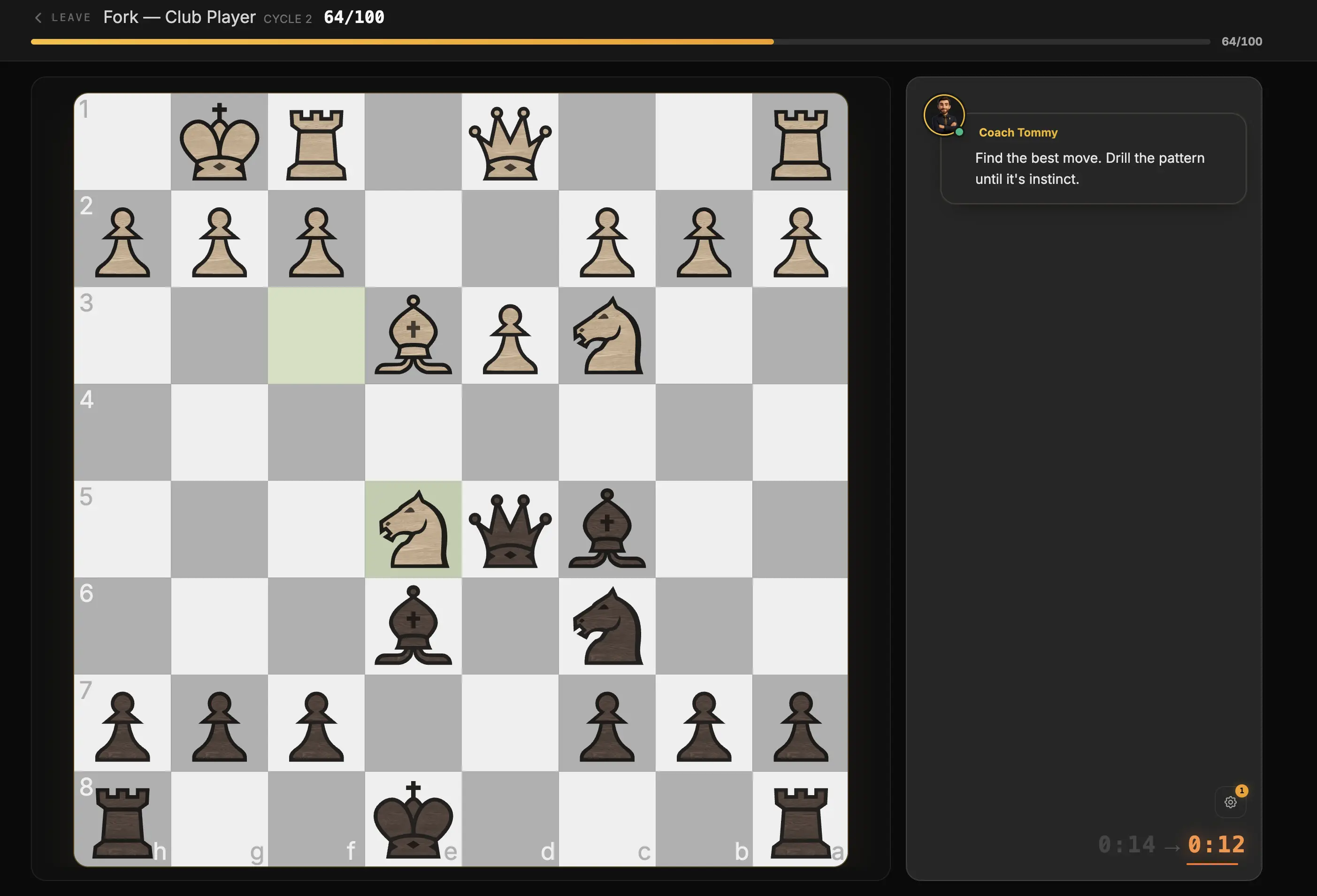
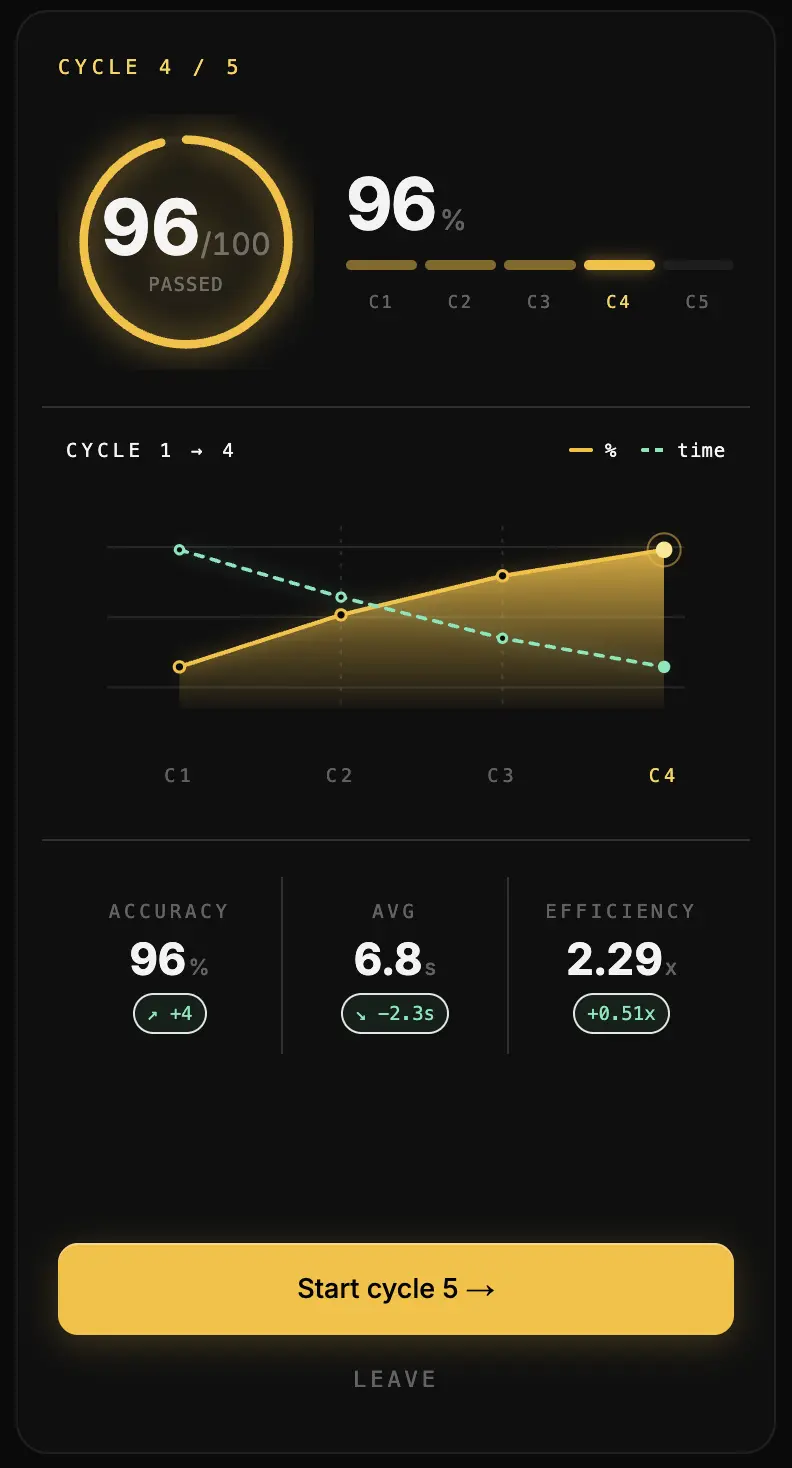
This is exactly the friction Chessigma's Woodpecker trainer removes. You pick a curated set and it handles the part humans quit over: it locks the set, tracks every puzzle's status per cycle, times each pass, and refuses to mark a puzzle passed unless you solved it cleanly with no wrong move, no hint and no solution shown.
The two rules, enforced for you:
- The do-better gate. The next cycle only unlocks if you match or beat both your previous accuracy and your previous average solve time. Every pass is genuinely faster and cleaner, not just repeated.
- Built-in rest. Cycles are spaced (gaps of roughly 1, 3, 7 then 14 days) so memory consolidates instead of being crammed.
Puzzles you fail drop into a free Mistakes pool you can drill on their own without touching cycle progress. The base sets are free; the only ask is an account so your cycles and times persist across sessions. Larger Extended sets sit under Supercoach if you want more volume, but a full, legitimate Woodpecker plan costs nothing. The trainer doesn't replace the method. It removes every reason people abandon it.
What Elo gain to actually expect
Be realistic. This is not an opening trick that wins next week. It's a multi-week project, and the payoff is specific: faster, more reliable tactical sight.
- Who gains most: players who are already decent positionally but slow or unreliable tactically, the ones who reach winning positions and let them slip.
- Why it moves the needle: below master level, tactics decide the majority of games, so sharpening the one skill that scales tends to move the rating that's been stuck.
- The catch: finish the full cycle plan once before judging it. Half a Woodpecker is just normal puzzle grinding with extra steps.
Start your first cycle today
Pick a curated set, solve it once, and let the gate handle the rest. The hardest part of the Woodpecker Method is the bookkeeping, and that part is already done for you.
Start your first Woodpecker setFrequently Asked Questions
What is the Woodpecker Method in chess?
The Woodpecker Method is a tactics training system from grandmaster Axel Smith and Hans Tikkanen. You build one fixed set of puzzles, solve every puzzle in it, then repeat the exact same set in progressively faster cycles until the patterns become automatic. The goal is recognition speed, not solving new positions.
How do you do the Woodpecker Method?
Pick a fixed set of tactical puzzles at your level, solve the whole set once with full calculation and nothing written down, then repeat the identical set again and again. Each cycle should take roughly half the time of the last. You finish when you can blitz the full set cleanly from memory of the pattern, not the answer.
What is the Woodpecker Method?
It is a spaced repetition training method for chess tactics. Instead of grinding endless fresh puzzles, you drill a single curated set on a tightening schedule so the motifs move from slow calculation into instant pattern recognition, the same way a woodpecker drills the same spot until it breaks through.
Is there a Woodpecker Method PDF or book?
Yes. The Woodpecker Method by Axel Smith and Hans Tikkanen is published by Quality Chess as a book and ebook, with a follow-up volume of harder positions. The book supplies the puzzle sets and the schedule; the hard part is the bookkeeping, which is what an automated trainer handles for you.
Does the Woodpecker Method actually gain you Elo?
It works because tactics decide most games below master level, and the method trains the one skill that scales: recognising a motif instantly instead of calculating it from scratch. Its own authors documented strong tournament results from it, and the biggest gains tend to go to players who were solid positionally but slow tactically.
Who is the Woodpecker Method for?
Players roughly 1200 to 2200 who calculate tactics correctly but too slowly, and who keep losing winning positions to a missed shot or to the clock. It is less useful for true beginners who still need to learn the basic motifs first, and for anyone who will not commit to repeating the same set instead of chasing new puzzles.