

Best chess AI tools in 2026: an honest roundup
The best chess AI in 2026 by use case: strongest engine, human-like sparring, talking coaches, and free instant analysis. Honest picks, rivals included.
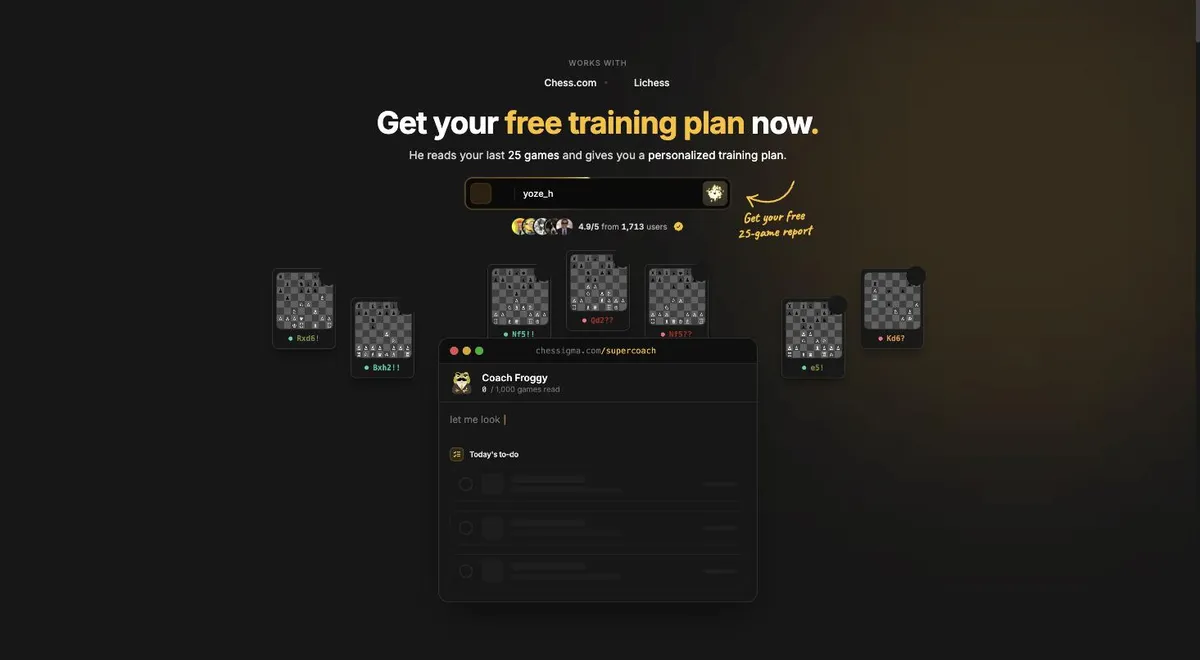
The best chess AI is not the strongest one, because every serious contender is already superhuman. Pick by job instead: deep analysis, an opponent that blunders like a person, a coach that explains the why, or a free answer in seconds. Cards on the table: we build Chessigma, which covers all four in one stack (Stockfish for the truth, Maia-style human play for the sparring, an agent system fed by your own games for the coaching). The rivals are in this roundup too, honestly described, because for a few narrow jobs one of them is still the right pick.
Need a move right now?
Set up any position and Stockfish 17 evaluates it in your browser. Free, instant, no account.
Get your next move from the chess AIHow to choose a chess AI (strength is the wrong filter)
No human has beaten a top engine in a match since the mid-2000s, and the Stockfish build on your phone would crush the world champion. What still separates these tools is everything the spec sheets skip: whether they can lose like a person, explain themselves, or answer free without an account. Here is the field, matched to the job each one wins:
| Tool | What it is | Pick it for |
|---|---|---|
| Chessigma Supercoach | Agent system combining Stockfish, Maia-style human play, and 12 months of your games | Fixing the mistakes you repeat, human-like sparring |
| Chessigma free tools | Stockfish 17 running in your browser, plus a free sparring rung | Instant next-move answers, unlimited game review |
| Stockfish 18 | Open-source engine, the strength benchmark | Deep analysis and opening prep |
| Leela Chess Zero | Self-taught neural engine, AlphaZero lineage | A second opinion with a different style |
| Maia (Lichess bots) | Research AI that imitates human play | Fixed-level sparring, free |
| Noctie | Adaptive human-like AI with feedback | Standalone sparring, paid |
| Chessvia | Talking coach layered on Stockfish | Free one-off position explanations |
| ChessMind AI | Maia-based opponents plus courses | Mobile-first practice |
The strongest chess AI: Stockfish 18
If the question is pure strength, the answer has been the same for years: Stockfish. Version 18 shipped in January 2026, measured up to 46 Elo stronger than Stockfish 17 in testing, and stayed free and open source. Since 2020 it has evaluated positions with a neural network (NNUE), so the old "engine vs AI" distinction is dead: the strongest engine is a neural-network AI stapled to a brutal search.
Its open-source rival, Leela Chess Zero, took the opposite road: it learned chess entirely from self-play in the AlphaZero style, with no human game data at the start. Strong players keep both around because they disagree in instructive ways. Leela leans into long-term pressure where Stockfish counts pawns.
The honest catch: Stockfish tells you what, never why. The eval bar says you're winning and leaves you to work out the reason. For most club players, raw engine output is a reference book, not a teacher.
Three ways to use Stockfish without installing anything:
- On one position: browser-based next-move calculators run Stockfish on your device. The one linked at the top of this page needs no account.
- On your whole game: Chessigma's game review grades every move with Stockfish, free and unlimited, because the engine runs in your browser.
- At full power: download Stockfish 18 from the official site and give it minutes per position for serious opening prep.
The most human chess AI: Maia and what got built on it
Here is the problem with training against Stockfish: it never hangs a piece, so you never practice punishing one. Your actual opponents blunder in patterns, and a separate branch of chess AI exists to reproduce exactly those patterns.
Maia, a research project from the University of Toronto, is a neural network trained to predict the move a human at a specific rating would play, not the best move. The free Lichess bots (maia1, maia5, maia9) were each trained on more than 10 million games from a single rating band, roughly the 1100s, 1500s, and 1900s. Play one and it misses the tactics a player at that level misses. The follow-up model, Maia-2, was presented at NeurIPS 2024 and predicts human moves even more accurately.
Chessigma's sparring ladder puts that research inside a training loop instead of leaving it as a standalone bot. The ladder's personas play Maia-style human chess and climb in strength family by family, and the first rung of every family plays free with no account. The part a standalone bot cannot do: the same platform analyzes your games and builds its drills from your real mistakes, so the sparring room sits next to a coach that knows what you keep getting wrong, instead of in its own silo.
Noctie takes the same idea commercial: trained on roughly a billion human games by its makers' count, it estimates your strength from your moves and keeps adapting as you improve, with per-move feedback and puzzles generated from your own mistakes. It runs on web, iOS, and Android with a seven-day free trial, then a subscription (14 euros a month, less on the yearly plan, as of publication).
ChessMind AI also builds its opponents on Maia, at six strength levels from about 1100 to 2000+, packaged with opening courses in a mobile-first app, with free and premium tiers. Like the Lichess bots, its opponents play at a level; they don't know your games.
| Tool | Feels like | Cost (as of publication) |
|---|---|---|
| Chessigma sparring ladder | Human-like personas inside a full training platform | First rung of every family free, no account |
| Maia bots | A fixed rating band, mistakes included | Free on Lichess |
| Noctie | An opponent that grows with you | 7-day trial, then subscription |
| ChessMind AI | Six Maia levels plus a study plan | Free tier, premium unlocks |
Talking chess AI coaches: tools that explain the why
The newest category pairs an engine with a language model. The engine picks the moves; the model translates them into English. That division of labor matters more than any feature list, because language models on their own are terrible chess players. ChatGPT drifts into illegal moves within a handful of turns when it plays raw, a failure reproduced in test after test, even while it discusses chess fluently.
The rule for judging any talking chess coach: the engine picks the move, the language model explains it. A tool that reverses that order is guessing at both.
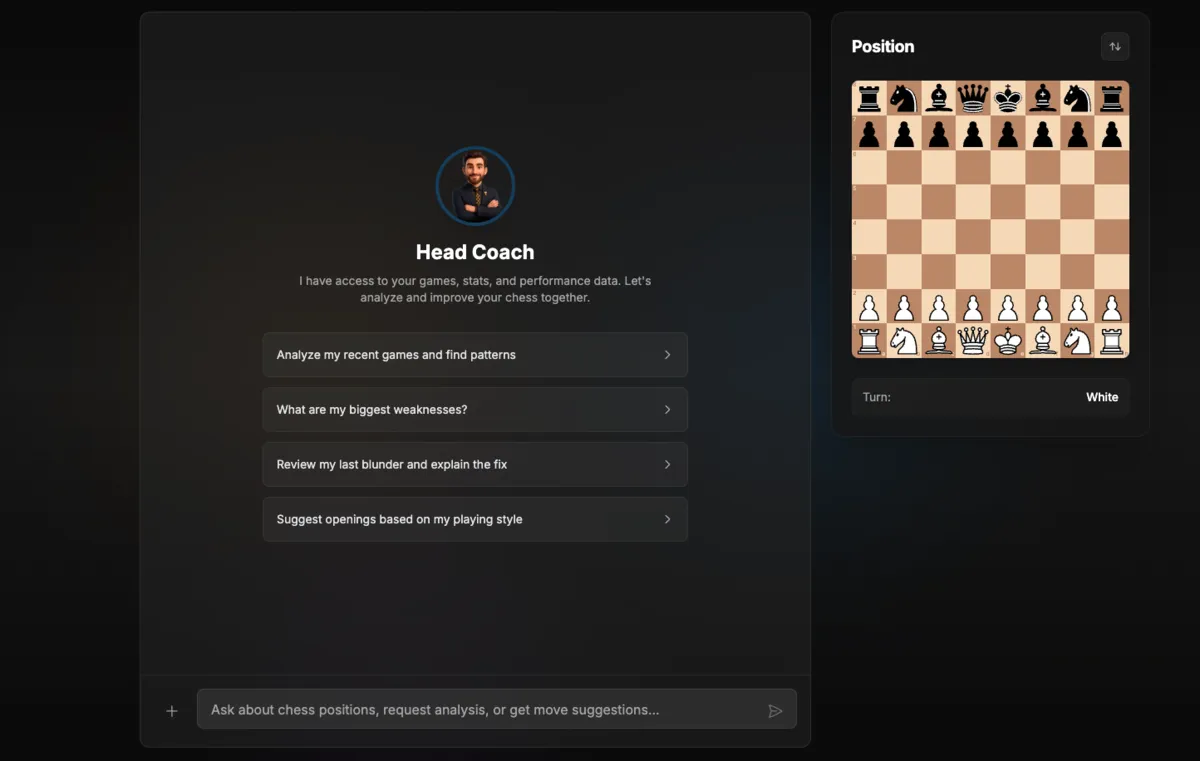
Chessigma's Supercoach is our entry here, and it takes that rule further than a chat window. Under the hood it is an agent system: Stockfish supplies the ground truth, Maia-style human-move models supply the human perspective on what players at your level actually find, and up to 12 months of your imported games supply the context. Out of that it builds a report of the mistakes you repeat, answers questions about your own play, and turns the answers into drills. It's a paid upgrade, tuned for players under 2000, and it is the only tool in this roundup that coaches you on your chess rather than on chess in general.
Chessvia is the free pick for the narrower job. Its coach, Chessy, answers by voice or text, while Stockfish runs locally in your browser to supply the actual evaluation. It works as a website and a Chrome extension that reads positions from the major chess sites, free with no signup as of publication. For explaining a single position with no history attached, it does that job well.
Free instant chess AI analysis: your next move and your whole game
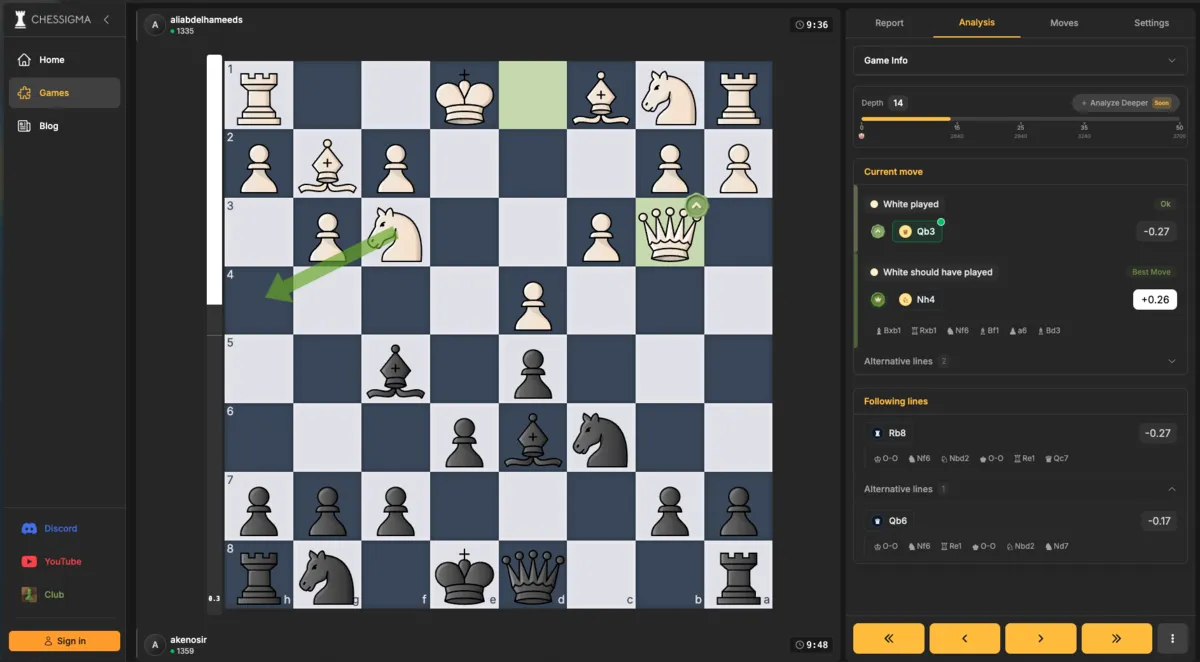
Most "chess AI" searches are really one of two questions: "what should I play here?" and "where did I lose that game?" The first is solved by next-move calculators that run Stockfish in your browser. Chessigma's calculator (the button at the top of this page) runs Stockfish 17 on your device with no signup, so the answer arrives in seconds and nobody meters your usage.
The second question needs full game review, and here the free tiers differ sharply. The reason Chessigma's review can be unlimited is architectural, not promotional: the analysis runs client-side on your device, so there is no server bill that forces a daily cap.
| Platform | Free game review | The catch |
|---|---|---|
| Chess.com | One Game Review per day (as of publication) | Unlimited reviews need a paid membership |
| Lichess | Free engine analysis, donation-funded | Numbers and arrows only, no coaching layer |
| Chessigma | Unlimited, every move graded | Runs on your device, so an old phone analyzes slower |
One line not to cross: consulting any of these tools during a live rated game gets accounts closed on every major platform. After the game, engine analysis is how everyone improves, titled players included. We map out exactly where that line sits in our take on whether using chess AI counts as cheating. And if you want a practical workflow for studying with one of these tools, our chess AI helper guide walks through it move by move.
Which chess AI should you use?
Match the tool to the sentence that sounds like you:
- "I keep losing to people my own rating." Spar with a human-like AI. Chessigma's ladder opens the first rung of every family free with no account; Maia's Lichess bots are free at three fixed levels. Stockfish can't show you human mistakes, and human mistakes are what you need to punish.
- "I need the best move in this position, now." Any Stockfish front-end works. The free calculator at the top of this page is the fastest route we know that skips the account wall.
- "I want moves explained in plain English." A talking coach. Supercoach if you want the explanations grounded in a year of your own games, Chessvia for free one-off explanations.
- "I'm preparing openings for tournaments." Download Stockfish 18 or Leela and pair it with a database. Nothing on this page, ours included, replaces that workflow at 2200+.
- "I make the same mistake every week." You need a tool with memory. Supercoach's report is built from your history for exactly this; Noctie's mistake puzzles cover it for its own games against you.
- "I don't want to spend anything." Lichess for playing, Chessigma for unlimited review and a free sparring rung, Maia for fixed-level sparring. That stack costs exactly zero.
Run every game you play through Stockfish
Import from Chess.com, Lichess, or a PGN file and get every move graded from Sigma to Clown. Unlimited, because the analysis runs in your browser, not on a metered server.
Analyze your games freeFrequently Asked Questions
What is the best chess AI in 2026?
It depends on the job. Stockfish 18 is the strongest engine, and it is free and open source. For human-like opponents, Chessigma's sparring ladder and the Maia bots reproduce real human mistakes. For coaching, Chessigma Supercoach combines Stockfish, Maia-style models, and 12 months of your own games in one agent system; Chessvia explains single positions free. For instant free analysis, Chessigma's next-move calculator answers with no signup.
What is the strongest chess AI?
Stockfish 18, released in January 2026, is the current strength benchmark in computer chess. It measured up to 46 Elo stronger than Stockfish 17 in testing and evaluates positions with a neural network. Leela Chess Zero, a self-taught neural engine built on the AlphaZero approach, is its closest open-source rival.
Can ChatGPT play chess?
Not reliably. ChatGPT can discuss chess fluently, but when it plays full games it regularly produces illegal moves, a failure documented across many independent tests. Use a tool where a real engine chooses the moves and a language model only explains them.
Is there a completely free chess AI?
Yes, several. Stockfish and Leela Chess Zero are free and open source. The Maia bots are free to play on Lichess. Chessigma's next-move calculator and game review are free with no signup, because the analysis runs in your browser instead of on a metered server, and the first rung of its sparring ladder plays free too.
Is using a chess AI cheating?
During a live rated game, yes, on every major platform, and accounts get closed for it. Analyzing your games after they finish is the opposite of cheating: it is standard practice at every level, including for titled players.
Is Stockfish an AI?
Yes, in the modern sense. Since 2020 Stockfish has evaluated positions with a neural network (NNUE), and Stockfish 18 shipped a new network architecture trained by its community. It pairs that learned evaluation with the deep search that made classical engines strong.