

Chess Puzzles Mate in 3: How to Solve Them (With Examples)
Learn how to solve chess puzzles mate in 3 with step-by-step examples. Train your tactics with free unlimited puzzles on Chessigma.
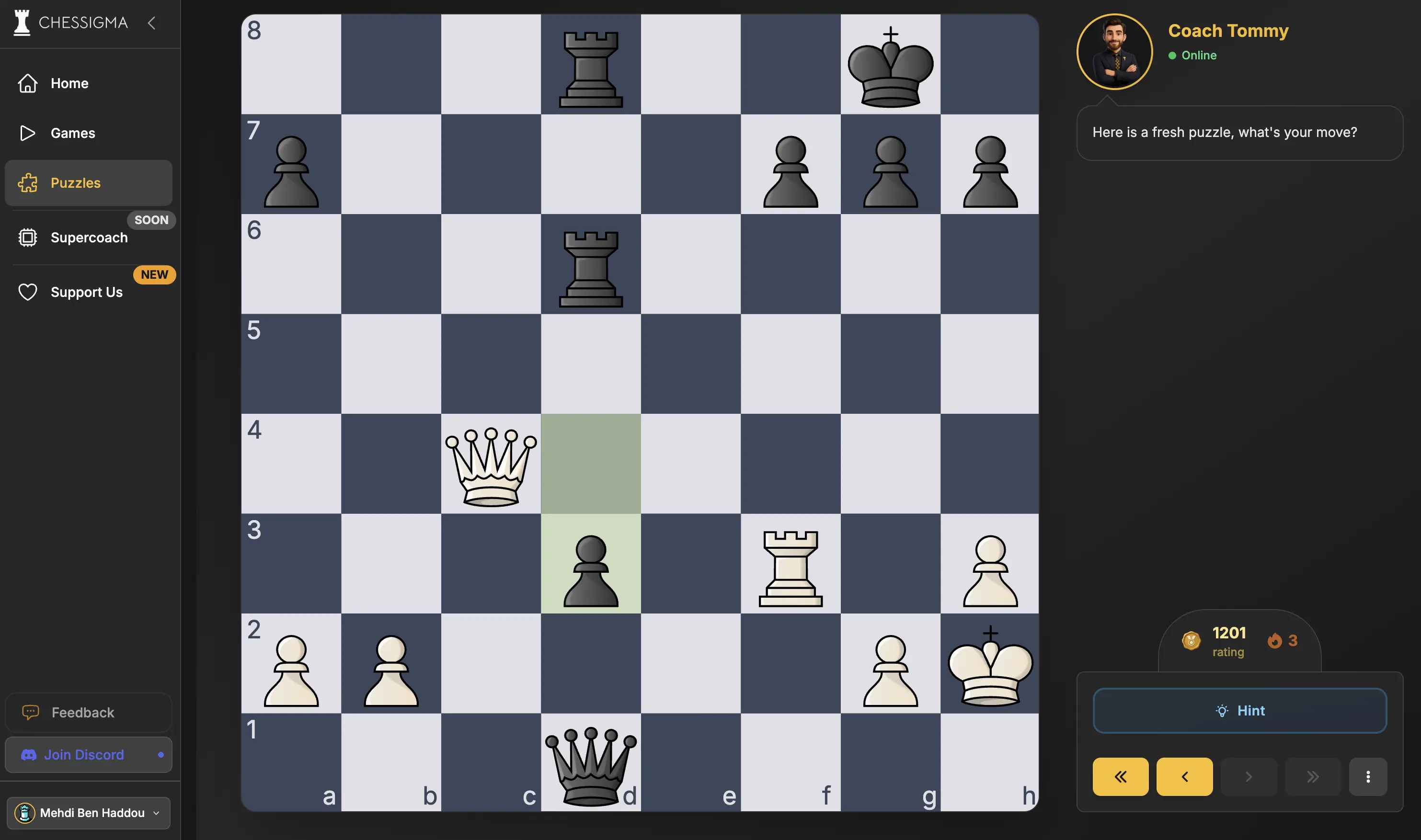
Chess puzzles mate in 3 are the sweet spot for tactical improvement. Harder than mate in 2 but still concrete enough to calculate completely, mate in 3 puzzles force you to think three full moves ahead and account for every opponent response. They build the exact tactics muscle that translates into real game wins. This guide breaks down how to solve them step by step, with examples at every level.
New to checkmate puzzles? Start with our mate in 2 guide first.
What Is a Mate in 3 Chess Puzzle?
A mate in 3 chess puzzle is a position where one side can force checkmate in exactly three moves, regardless of what the opponent plays. That last part is the key phrase. You're not just finding a line that works if the opponent plays badly. You need to prove that every possible defensive response still leads to checkmate by move three.
This means calculating branches. If the opponent blocks, you have an answer. If they move the king, you have an answer. If they interpose a piece, you have an answer. Mate in 3 chess puzzles test whether you can hold multiple variations in your head simultaneously.
Why Mate in 3 Puzzles Make You a Better Chess Player
Three concrete reasons these puzzles accelerate your improvement more than almost any other training method:
They force complete calculation. In a mate in 2, you check, they respond, you mate. Simple. In a mate in 3, you can't stop at the first good-looking move. You need to see the full line. This trains the discipline of calculating to the end instead of playing the first move that feels right.
They train you to consider opponent counterplay. This is the core skill that separates 1200 from 1600 players. At every move, you must ask: "what's my opponent's best defense?" That habit transfers directly to your games.
They build pattern recognition for intermediate moves. Many mate in 3 solutions require a quiet move (zwischenzug) - a non-check that sets up an unstoppable threat. These appear constantly in real games, and solving mate in 3 puzzles is the fastest way to wire that pattern into your brain.
How to Solve Chess Puzzles Mate in 3 - Step by Step
To solve a mate in 3 puzzle, start by identifying all forcing moves (checks, captures, and threats), then calculate the opponent's best defensive response to each one, and verify your three-move sequence works against every reply.
Here's the full process:
- Look for checks first. List every check available in the position. Checks are forcing - your opponent must respond to them. This narrows the tree of possibilities immediately.
- Identify the opponent's defensive resources. For each candidate first move, ask: what can they do? Can they block? Move the king? Interpose a piece? Capture the attacker? List every legal response.
- Find the move that takes away the most escape squares. The best first move often restricts the king's movement rather than giving check. Cutting off escape routes makes the follow-up forced.
- Calculate the full 3-move line for each candidate. Don't stop at "this looks good." Play it out mentally: your move, their best response, your second move, their best response, your checkmate. All three pairs.
- Verify against all defensive responses. Your solution must handle every reply, not just the main line. If even one opponent response escapes mate, your solution is wrong.
The most common mistake: players find the first two moves easily but miss that the opponent has a defensive resource on move two that ruins the combination. A blocking move, a counter-check, an unexpected interposition. Train yourself to always ask "what is my opponent's best response?" at every single move in the sequence.
Mate in 3 Puzzle Examples (Beginner to Advanced)
Example 1 - Beginner: Back Rank Mate with a Clearing Move
Position: White has a rook on d1, a queen on d3, and the king is castled on g1 with pawns on f2, g2, h2. Black's king is on g8 with pawns on f7, g7, h7 (classic back rank setup). Black has a rook on e8 defending the back rank.
Solution:
- 1. Qd7 - Attacks f7 and clears the d-file for the rook. Black must deal with the threat on f7. After 1...Re7, the only way to defend.
- 2. Qd8+ - Queen invades the back rank with check. 2...Re8 is forced, blocking the check.
- 3. Rxe8# - The rook delivers checkmate on the back rank. The pawns on f7, g7, h7 trap Black's own king.
This mate in 3 pattern is one of the most common in real games. The clearing move (Qd7) is what beginners miss - they look for an immediate back rank check and don't find one. The key pattern: when the back rank is weak, look for ways to force your heavy pieces onto it, even if the first move isn't a check.
Example 2 - Intermediate: Queen Sacrifice into Smothered Mate
Position: White has a queen on f7 and a knight on g5. Black's king is on g8 with a rook on f8 and pawns on g7, h7. The f7 queen is attacking but can't deliver mate alone.
Solution:
- 1. Nh6+ - Double check from the knight. The king must move (you can't block or capture two attackers). 1...Kh8 is forced.
- 2. Qg8+! - Queen sacrifice. Black must capture: 2...Rxg8.
- 3. Nf7# - Smothered mate. The knight delivers checkmate while Black's own pieces (rook on g8, pawn on h7, pawn on g7) block every escape square.
This is Philidor's Legacy - one of the most beautiful mate in 3 patterns. The queen sacrifice on g8 is the move that shocks players the first time they see it. Once you've solved this pattern a few times, you'll start spotting smothered mate setups in your own games.
Example 3 - Advanced: Quiet First Move Setting Up an Unstoppable Mate
Position: White has a queen on h5, a bishop on c1, and a rook on e1. Black's king is on g8 with pawns on f7, g6, h7. Black has a knight on f6 blocking the h5-f7 diagonal.
Solution:
- 1. Bh6! - A quiet move. No check, no capture. But it threatens Qg7# and cuts off the king's escape to h8. Black must deal with the Qg7# threat. 1...Nh5 (trying to block with the knight) or 1...Ne8.
- 2. Qxf7+ - Now the queen crashes in. 2...Kh8 is forced.
- 3. Qg7# or 3. Qf8# depending on Black's defense - checkmate. The bishop on h6 covers g7 while the queen delivers the final blow.
This is the hardest type of mate in 3 puzzle. The first move isn't a check - it's a quiet positional move that creates an unstoppable threat. Advanced players recognize this pattern: when the king is hemmed in, sometimes the strongest move is one that takes away the last escape square rather than giving check immediately.
To practice these at speed, play a timed checkmate puzzle rush: two minutes of mates in 1, 2 and 3 against a defender that finds the longest line, then the classic endings.
Mate in 3 vs Mate in 2 - What's the Difference in Difficulty?
The jump from mate in 2 to mate in 3 is bigger than it sounds. A mate in 2 has one forcing move and one response to calculate. A mate in 3 introduces a full extra layer of opponent counterplay - that's exponentially more branches to evaluate.
Most players who solve mate in 2 puzzles consistently will struggle with mate in 3 at first. That's normal. The solution isn't to just grind harder - it's to go back and solve more mate in 2 puzzles until the patterns become instant recognition. When you can spot mate in 2 within seconds, your brain has the bandwidth to extend that calculation one move deeper.
Check out our mate in 2 puzzles guide if you need to sharpen your foundation before tackling mate in 3.
How Many Mate in 3 Puzzles Should You Solve Per Day?
5-10 mate in 3 puzzles per day with full calculation beats 50 rushed ones every time. Quality over quantity.
Here's why: rushing puzzles trains you to guess rather than calculate. When you click the first move that looks right without verifying all defensive responses, you're building the habit of incomplete calculation - the exact opposite of what mate in 3 training should develop.
10 properly solved puzzles where you calculated every branch builds real tactical skill. 50 click-through puzzles just builds speed at guessing. The players who improve fastest are the ones who spend 2-3 minutes per puzzle confirming their solution handles all replies.
Want to combine puzzles with full game review? Learn how to analyze your chess games to find the tactical patterns you keep missing.
Practice Mate in 3 Puzzles Free - No Limit
Chessigma has 4M+ puzzles including mate in 3 positions at every difficulty level. Unlimited free practice with an Elo rating system that matches you to the right challenge - not too easy, not impossible, just right for growth.
Unlike Chess.com's 5 puzzle daily limit, you can solve as many mate in 3 chess puzzles as you want without hitting a paywall. Track your progress, watch your puzzle Elo climb, and build the tactical vision that wins real games.
Frequently Asked Questions
What is a mate in 3 chess puzzle?
A mate in 3 chess puzzle is a position where one side can force checkmate in exactly three moves, regardless of how the opponent responds. You need to find a sequence of three moves that leads to checkmate no matter what defensive moves the opponent plays.
How do you solve a mate in 3 puzzle?
Start by listing all checks and forcing moves. Then calculate the opponent's best defensive response to each one. Find the move that restricts the king the most, calculate the full three-move line, and verify your solution works against every possible reply - not just the obvious one.
Are mate in 3 puzzles good for beginners?
Mate in 3 puzzles work best for players who can already solve mate in 2 consistently. If you're a complete beginner, start with mate in 1 and mate in 2 puzzles to build pattern recognition first. Once those feel easy, mate in 3 is the natural next step.
What is the difference between mate in 2 and mate in 3?
Mate in 2 requires finding one forcing move followed by checkmate. Mate in 3 adds a full extra layer of opponent counterplay to calculate, which exponentially increases the number of variations you need to consider. The jump in difficulty is significant.
How many chess puzzles should I solve per day?
5-10 puzzles solved with full calculation beats 50 rushed ones. Focus on calculating every branch before moving, not speed. Consistency matters more than volume - solving puzzles daily builds stronger pattern recognition than marathon sessions.
Where can I find free mate in 3 chess puzzles?
Chessigma offers 4M+ free chess puzzles including mate in 3 positions at every difficulty level. Unlimited daily practice with an Elo rating system, no paywall, and no daily limit. Start solving at chessigma.com/puzzles.