

What is a Brilliant Move in Chess? Definition, Examples & How They're Detected
What makes a chess move 'brilliant'? Learn how Chess.com, Lichess, and Chessigma detect brilliant moves, see famous examples, and find brilliant moves in your own games.
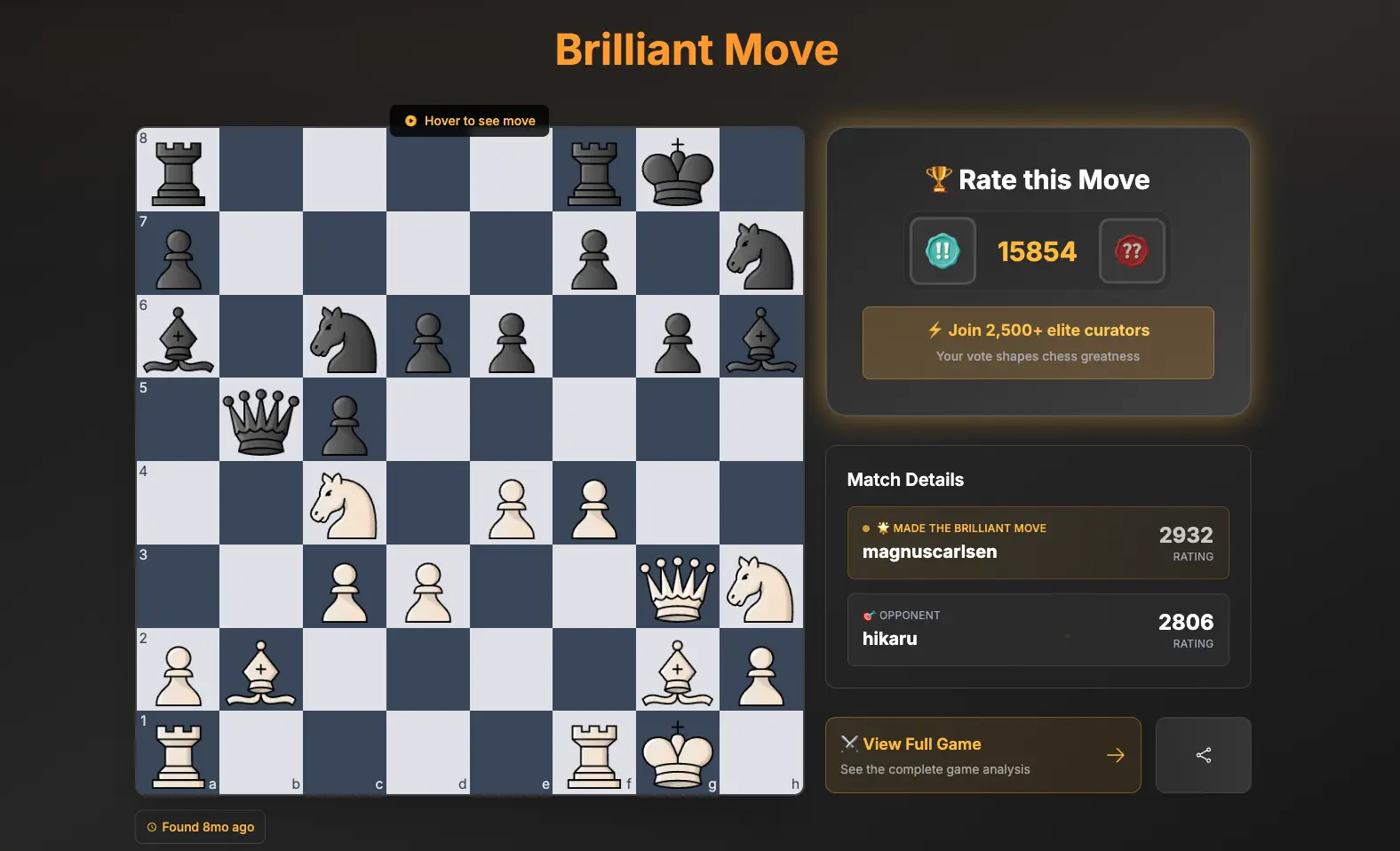
A brilliant move in chess is the highest classification a move can receive during game analysis, and it indicates a move that is not only the best option, but one that required deep calculation and was difficult to find. Made famous by Chess.com's game review system, the brilliant move (marked with !!) has become one of the most coveted accolades in online chess. But what exactly makes a move "brilliant," and how do chess engines decide?
What Makes a Move Brilliant?
Not every strong move earns the brilliant label. A brilliant move is typically defined by a specific combination of factors that separate it from merely "great" or "best" moves.
A move is considered brilliant when it meets these criteria:
- ♚It's the best or near-best move in the position, because the engine confirms it leads to the strongest continuation
- ♚It involves a non-obvious sacrifice: material is given up (a piece, a pawn, an exchange) for a positional or tactical advantage
- ♚The engine initially evaluates it as bad: at shallow depth, the sacrifice looks losing. Only after deep calculation does the advantage reveal itself
- ♚It was difficult to find: obvious winning moves are classified as "great" or "best," not brilliant. The brilliance lies in the depth of vision required
The key distinction is sacrifice + depth. A brilliant move almost always means you gave up material for an advantage that only becomes clear after deep calculation. A queen sacrifice that leads to checkmate in 8 moves? That's brilliant. Playing the engine's top move in a quiet position? That's just good chess.
How Different Platforms Classify Brilliant Moves
Not all platforms agree on what "brilliant" means. Here's how the major chess platforms handle move classification.
Chess.com's Classification
Chess.com popularized the brilliant move concept. Their system uses Stockfish analysis post-game and classifies moves on a scale:
Brilliant (!!) > Great (!) > Best > Excellent > Good > Inaccuracy (?!) > Mistake (?) > Blunder (??) > Missed Win
For a move to earn the brilliant badge on Chess.com, it must involve a material sacrifice, the evaluation must remain favorable after the sacrifice, and the move must not be part of an obvious forced sequence. The sacrifice is the non-negotiable requirement: no sacrifice, no brilliant.
Lichess
Lichess takes a different approach. Their analysis engine classifies moves as Best, Excellent, Good, Inaccuracy, Mistake, or Blunder, but there is no dedicated "brilliant" classification. Some third-party tools add brilliant detection on top of Lichess analysis, but the platform itself doesn't assign the label.
Chessigma's Move Quality System
Chessigma uses a unique 9-level grading system that goes beyond traditional classification. The grades range from Sigma (the absolute best, equivalent to a brilliant move) down to Clown (the worst).
Sigma moves represent exceptional plays that demonstrate deep tactical vision. Unlike Chess.com's system, Chessigma's analysis is completely free and unlimited: you can analyze every game, every move, without hitting a paywall. And when you find a move you're proud of, you can submit it to the Brilliant Moves Leaderboard where the community votes on the most impressive plays.
Famous Brilliant Moves in Chess History
The most memorable chess games often feature a single moment of brilliance: a move so unexpected that it changes everything. Here are three of the most celebrated brilliant moves ever played.
Bobby Fischer vs Donald Byrne, 1956, "The Game of the Century"
The move: Be6!!
13-year-old Bobby Fischer played a stunning queen sacrifice against one of America's top players. By allowing his queen to be captured, Fischer unleashed a devastating attack with his minor pieces that left Byrne completely helpless. The combination that followed involved discovered checks and a relentless assault on the king. Fischer won material back with interest and delivered checkmate. This game earned its nickname because a teenager dismantled an experienced master with a sacrifice that defied conventional wisdom.
Garry Kasparov vs Veselin Topalov, Wijk aan Zee 1999
The move: Rxd4!!
Kasparov sacrificed a rook to blow open Topalov's king position, launching one of the deepest combinations ever seen in competitive chess. The sacrifice initiated a 15-move sequence where Kasparov gave up both rooks and kept finding only moves to maintain the attack. The engine needed significant depth to confirm the sacrifice was sound. This game is widely considered the greatest attacking game of all time.
Wei Yi vs Lazaro Bruzon, Danzhou 2015
The move: Bf8!!
In one of the most spectacular attacking games of the 2010s, 16-year-old Wei Yi played a quiet bishop retreat that set up an unstoppable mating attack. After a series of sacrifices including a rook and a knight, this calm bishop move sealed the deal, and the threat was so deep that Bruzon had no defense. The game has been compared to the greatest attacking masterpieces in chess history, and the combination that followed is now a staple of tactical training material.
How to Find Brilliant Moves in Your Games
You don't need to be a grandmaster to play brilliant moves. Every player has moments of deep calculation, and you just need to find them. Here's how:
- 1.Play your game on Chess.com, Lichess, or any platform
- 2.Import it to Chessigma: paste the PGN or link your Chess.com / Lichess account for automatic import
- 3.Run the free analysis: Chessigma's Stockfish 16 engine evaluates every single move in your game
- 4.Look for Sigma-rated moves: these are your brilliant moments, the moves where you saw deeper than the surface
- 5.Submit to the leaderboard: share your best moves with the community and see how they stack up
How to Play More Brilliant Moves
Brilliant moves aren't random. They come from trained pattern recognition and the willingness to calculate deeply. Here's how to increase your chances:
- ♚Study tactical patterns: most brilliant moves involve tactics like pins, forks, discovered attacks, and deflections
- ♚Don't fear sacrifices: when the position is sharp, consider giving up material if the resulting position gives you a lasting initiative
- ♚Calculate deeply: brilliant moves live in the branches, not on the surface. Push your calculation one or two moves further than feels comfortable
- ♚Practice puzzles: tactical vision built through puzzle training transfers directly to real games
- ♚Review your analyzed games: studying your own missed brilliancies teaches you to spot those patterns next time
Sharpen your tactical vision with unlimited free puzzles
Frequently Asked Questions
What is a brilliant move in chess?
A brilliant move is a non-obvious sacrifice that turns out to be the best move in the position. It requires deep calculation to find and is marked with !! in game analysis. The sacrifice element is key: the move must give up material for an advantage that only reveals itself through deep engine calculation.
How does Chess.com determine brilliant moves?
Chess.com uses Stockfish engine analysis. A move is classified as brilliant when it involves a material sacrifice, the position remains favorable after the sacrifice, and the move was not obvious or forced. The system also checks that the sacrifice wasn't part of a simple forced sequence.
Can you get a brilliant move with a pawn?
Yes. A pawn sacrifice that opens a decisive attack or creates an unstoppable passed pawn can absolutely be classified as brilliant. Some of the most beautiful brilliant moves in chess history involve quiet pawn pushes that unlock devastating combinations.
How many brilliant moves is a lot?
Most games have zero brilliant moves. Getting one in a game is noteworthy. Getting two or more is exceptional and suggests a high-quality attacking game with deep calculation. Even top grandmasters don't play brilliant moves in every game.
Is a brilliant move always a sacrifice?
On Chess.com, yes: their system requires a material sacrifice for the brilliant classification. On other platforms, the definition may vary. On Chessigma, the "Sigma" rating captures exceptional moves that may or may not involve sacrifices, focusing instead on the overall quality and depth of the move.
Ever wondered which review tool actually catches these moves? We took 100 brilliant moves labeled by Chess.com's Game Review and replayed them through every major review tool, board by board. See who found them in the brilliant move benchmark.
Want to learn more about how Chessigma grades your moves? Read our guide to how Chessigma analysis works. Or jump straight in and analyze your games for free.