

Best Chess Openings for Beginners, Ranked by Data
The best chess openings for beginners, ranked by how they actually score in club games. Five openings, the exact moves, and a free trainer for each.
Every list of the best chess openings for beginners ranks them by taste. This one ranks them by how they actually score: 2.08 billion real games between 1000 and 1600, one number per opening, pulled from the Lichess database and shown below with the method. Four of the openings that appear on almost every beginner list score below average for the side playing them, and the one every list opens with is only the fifth best White opening measured here.
Drill any linked opening on this page, free
Chessigma's opening trainer plays your side move by move, answers back with what club opponents actually play, and explains the moves as you go. No signup needed, and the first five lines of every course are free.
Open the chess openings trainerWhat "best" means here, and why the percentages you have seen are misleading
"Best" on this page means one thing: the opening scores well when players at your strength play it. Not that a grandmaster would approve of it. Every number comes from the Lichess opening explorer, filtered to blitz and rapid games in the 1000 to 1600 rating band, and each opening is measured at the position that defines it. Score is the normal chess convention, (wins + draws/2) / games, from the point of view of the side who chose the opening.
Here is the part every other list gets wrong. White already scores above 50% before choosing anything. So a White opening at 52.9% is not 2.9 points ahead of the field, it is 1.0 point ahead. And a Black defense at 48.3% is not losing, it is exactly average. You have to compare each opening against its own side's baseline, or you will rate every White opening as good and every Black one as bad. It also means White scores and Black scores are never comparable to each other, only each to its own baseline.
| Baseline, 1000 to 1600 | White scores | Black scores | Games |
|---|---|---|---|
| All games | 52.0% | 48.0% | 2,081,722,101 |
| After 1. e4 | 51.9% | 48.1% | 1,364,217,598 |
| After 1. d4 | 52.7% | 47.3% | 464,350,518 |
Two honest caveats, because a number without its limits is just a claim. Each opening's score is conditional on reaching it: the Italian Game figure only counts games where Black cooperated with 1...e5 and 2...Nc6. That is the right question for a beginner ("if I get to play this, how does it go?") but it is not a measure of objective strength. And these are averages over millions of players who all had to keep playing after move three, so what they really measure is how easy an opening is to play well. That is exactly what you want when choosing your first repertoire, and it is not the same list an engine would give you.
One more thing about the five picks, so the ranking is auditable. They are the highest scorers that also do a job: one opening as White, one answer to 1. e4, one answer to 1. d4, and a free course to drill each. Two openings outscore some of them and are deliberately not in the list. The Queen's Gambit is +2.6 and beats the London, at the price of learning answers to the Slav, the Queen's Gambit Declined and half a dozen Indian defenses. The gambits outscore everything and get their own section at the end. Both are named with their numbers rather than quietly dropped.
The four principles that beat any opening choice
Compare like with like and the whole spread on this page is small: from the best White opening (56.6%) to the worst (50.2%) is six points, and the Black defenses run from 50.8% down to 42.6%. Hanging a piece in a club game costs you far more than any of that. So before the list, the four rules that decide the other 30 moves. An opening is only a way of reaching these faster.
- 1. Take the centre with a pawn. e4, d4, e5, d5, c5. Pawns in the middle take squares away from your opponent's pieces and give yours somewhere to stand.
- 2. One move per piece, knights and bishops first. Every opening in the top five is three or four developing moves in a fixed order. The queen comes out late or she gets chased around while your opponent develops for free.
- 3. Castle by move ten. The king in the middle is why beginners lose games they were winning. If your opening plan has not castled by move ten, you have chosen the wrong plan.
- 4. Before every move, ask what changed. What is your opponent now attacking that they were not attacking last move? This one habit is worth more than any opening on this page.
1. Scotch Game, 55.5% for White: your opening with the white pieces
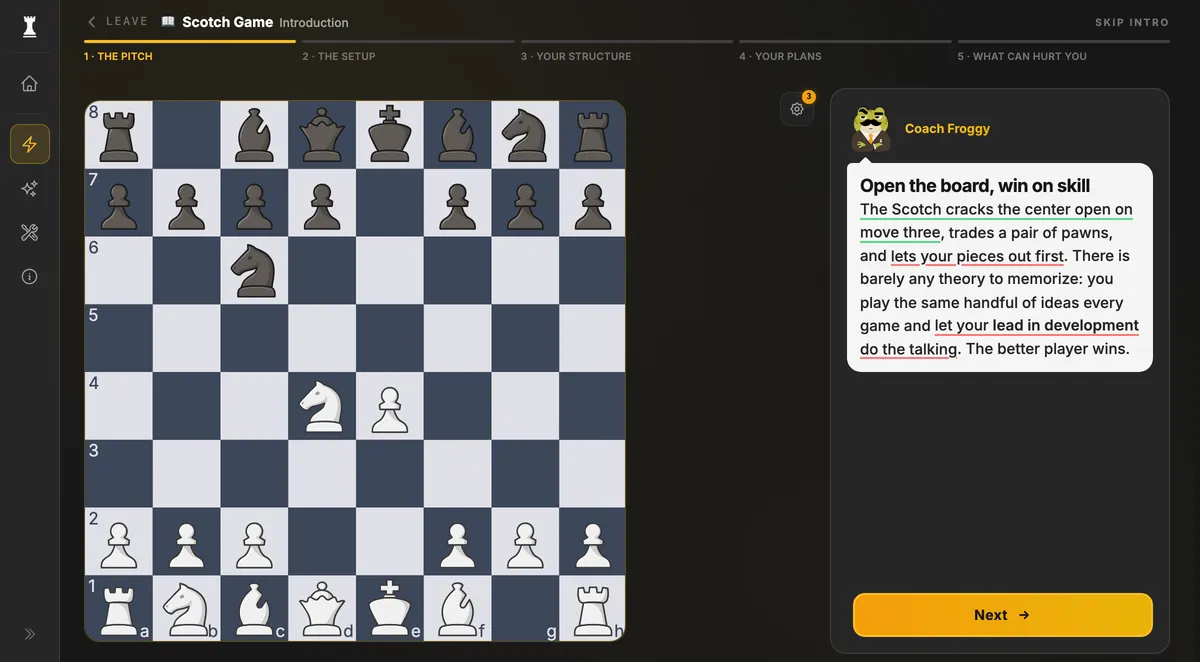
1. e4 e5 2. Nf3 Nc6 3. d4. White scores 55.5% across 48.0 million games, which is 3.6 points above what White scores after 1. e4 in general. Among openings a beginner can safely be handed, nothing else on the board comes close, and it beats the Italian Game, the pick every other beginner list opens with, by 2.6 points.
Why it works at club level: the third move trades your d-pawn for Black's e-pawn and rips the centre open immediately. That matters because the way beginners lose with 1. e4 e5 openings is by drifting in a closed, slow position with no idea what to do. The Scotch removes the option. Pieces come out fast, lines are open, and the player who counts better wins.
The whole opening, in four moves
1. e4 e5
Both sides claim the centre. This is the most common position in chess after one move each.
2. Nf3 Nc6
You attack e5, Black defends it. Standard, and it is where the Italian and the Ruy Lopez also start.
3. d4
The Scotch. You hit e5 a second time, and Black cannot hold it: the pawn on e5 is attacked twice and defended once.
3... exd4 4. Nxd4
Your knight lands in the middle of the board, your bishops both have open diagonals, and you castle next. From here the plan is simple: develop, castle, then push a pawn at whichever side of the board Black has neglected.
The one line to know: after 4... Bc5, the natural 5. Nxc6 runs into 5... Qf6, which hits the knight and looks down the f-file at once. It is perfectly fine for White, you just need the reply ready: 6. Qd2 or 6. Qf3. If you would rather not deal with it, 5. Be3 holds everything together. Train the Scotch line by line and the board plays Black's most common replies back at you.
2. Caro-Kann Defense, 50.8% for Black: the cheapest answer to 1. e4
1. e4 c6, and next move d5. Black scores 50.8% over 72.8 million games, 2.7 points above Black's 48.1% baseline against 1. e4. It ties the Sicilian for the best margin over baseline of any Black defense measured here, and it costs a fraction of the study.
The trade you are making: you support d5 with a pawn instead of a piece, so you get a solid structure and no early tactics to memorise. You give up speed. This is the defense for a player who would rather understand one position than remember ten. After the near-universal 2. d4 d5 White has four serious tries and only two show up often at club level, so your homework is genuinely small. White can also duck with 2. Nc3, 2. Nf3, 2. c4 or the 3. f3 Fantasy, all rarer and none of them dangerous once you know your structure.
| White plays | Called | Your reply, in one line |
|---|---|---|
| 2. d4 d5 3. e5 | Advance | Develop the bishop outside the chain with Bf5 before playing e6. |
| 2. d4 d5 3. Nc3 | Main line | Take with dxe4, then Bf5 and a comfortable game. |
| 2. d4 d5 3. exd5 | Exchange | Recapture with cxd5 and play the symmetrical position. |
| 2. d4 d5 3. exd5 cxd5 4. c4 | Panov | The sharpest try, and the rarest below 1600. Develop with Nf6 and e6. |
Train the Caro-Kann against all four. It is the course to take if you want one defense and no maintenance.
3. Sicilian Defense, 50.8% for Black: the same score, three times the work
1. e4 c5. Black scores 50.8% across 164.1 million games, the largest sample of any named defense here apart from 1... e5 itself, and the same 2.7 points above baseline as the Caro-Kann. Identical result, very different price.
The reason it is fourth and not first is the bill. White decides the battleground on move two, and roughly half of your club games never reach the Sicilian you studied: they turn into an Alapin, a Closed Sicilian, a Smith-Morra or a bishop out to c4. So a Sicilian repertoire is one system plus a prepared answer to five sidelines, where the Caro-Kann is one structure plus four replies. Take it because you want to play for the win from move one with an unbalanced position, not because it scores higher, because it does not.
| Caro-Kann | Sicilian | |
|---|---|---|
| Score for Black | 50.8% | 50.8% |
| Games measured | 72,838,675 | 164,111,341 |
| What you must learn | One structure, four White tries | One system, plus five anti-Sicilians |
| Type of game | Solid, slow, few forced lines | Unbalanced, sharp, real winning chances |
| Cost of a mistake | A worse position | The game, in the sharp lines |
If you take it, train the Sicilian with the anti-Sicilians included. A Sicilian course that only teaches you the main line has taught you half your games. Chessigma's teaches the Dragon as its Open Sicilian system, which is the point of picking one: you get the same picture every game.
4. King's Indian Defense, 49.1% for Black: your answer to 1. d4
1. d4 Nf6 2. c4 g6 3. Nc3 Bg7 4. e4 d6, the real King's Indian tabiya rather than the 2... g6 junction it shares with the Gruenfeld and the Benoni. Black scores 49.1%, which is 1.8 points above Black's 47.3% baseline against 1. d4, and that makes it the only named answer to 1. d4 measured here that clears its baseline by more than a point. Every classical reply scores worse: the Nimzo-Indian is +0.7, the Dutch +0.1, the Slav 0.4 below, the Queen's Gambit Declined 1.3 below, and the Queen's Gambit Accepted 4.7 below.
The caveat, stated plainly: 2.14 million games is the smallest sample behind any of these five picks, because measuring the real tabiya means both players committing six moves deep. Measured one move earlier, at the shared 2... g6 junction, Black scores 50.2% over 5.9 million games. Both numbers clear the baseline; the deeper one is the honest one to put next to the opening's name.
It works for the same reason the London works for White: it is a setup, not a theory tree. You play the same five moves against almost anything, then you have one clear plan.
- The setup, in this order: Nf6, g6, Bg7, d6, then O-O. Play d6 before castling, not after: castling first invites e5, which is the standard punishment and the reason the main lines are ordered this way.
- The bishop is the point. On g7 it looks down the long diagonal all the way to White's queenside. Do not trade it off for a knight without a reason.
- Then break the centre. Once you are castled, hit it with e5 (the classic) or c5 (against slower setups). Timing is the whole skill here: too early and you are pushed back, never and White simply keeps the extra space.
- If White never plays c4 and goes for the London instead, the same fianchetto still works, so this one setup covers most of what you will meet after 1. d4.
Train the King's Indian move by move, including the e5 break, which is the move that decides whether the whole setup was worth playing.
5. London System, 54.4% for White: one setup against everything
1. d4 d5 2. Bf4. White scores 54.4% over 53.3 million games, 1.7 points above the 52.7% White scores after 1. d4. That figure is measured at the position above, the accelerated move order against 1... d5, which is where roughly half of your 1. d4 games go. It has the smallest edge of the five and the Queen's Gambit beats it at +2.6, and it is still here, because it is the cheapest opening in chess to own: the same eight moves against almost anything.
- 1. d4 and Bf4, bishop outside the pawn chain before anything can shut it in.
- 2. e3, c3, building the pawn triangle that holds the whole structure together.
- 3. Nf3, Nbd2, Bd3, O-O. Done. Now pick a side of the board.
- Two moves to prepare for: Qb6 hitting the b2 pawn your bishop stopped guarding, and an early Bf5, where you switch plans and strike with c4 instead.
The honest downside is the mirror of the upside: autopilot gets you a playable position and nothing more, so the London rewards knowing your two or three attacking patterns. Train the London System and you will meet all of them inside an hour.
The openings to skip, and the three that outscore all five
Three openings score higher than the Scotch and are still not on the list. The 4. Ng5 Knight Attack, the gateway to the Fried Liver, is the best-scoring White position measured here at 56.6%. The Danish Gambit is at 55.8% and the King's Gambit at 55.6%. They are missing for two reasons, and neither is that they are bad.
- They need permission, and the numbers show it. 4. Ng5 only happens if Black plays 3... Nf6. Push on to the Fried Liver itself, 4... d5 5. exd5 Nxd5 6. Nxf7, and White scores 71.3% over 3.2 million games. That is the highest number in this whole dataset and it is also the least useful, because it only exists when your opponent walks into it. You cannot build a repertoire on their cooperation.
- The edge is borrowed, not earned. A gambit's score comes from opponents who do not know the refutation. That number is real today and shrinks every hundred rating points, whereas the Scotch's 3.6 comes from an open position you understand better.
- Play them anyway, on purpose. Sharp gambits teach attacking patterns faster than anything else. Just know you are buying rating points now and paying for them at 1600.
Now the ones to leave alone, all of them measured below their own side's baseline:
- Queen's Gambit Accepted, 42.6% for Black (4.7 below baseline). The worst result on this page by a distance, over 27 million games. Beginners are taught to take the pawn on c4. Taking it hands White the whole centre, and the pawn usually comes back anyway. Play something else against the Queen's Gambit.
- Petrov Defense, 46.5% (1.6 below). Also spelled Petroff. Symmetrical, respectable, and it quietly loses ground at club level because the resulting positions are dry and White has the easier plan.
- Queen's Gambit Declined, 46.0%, and the Slav, 46.9% (1.3 and 0.4 below). Both are perfectly sound openings that need real understanding of a locked centre to hold. That understanding arrives after 1600, not before.
- 1... e5 itself, 47.0% (1.1 below), across 743 million games. The single most recommended move for Black in beginner chess scores below Black's own average. Be careful how much you read into that one: 743 million of the 1.36 billion games after 1. e4 go here, so it is measured largely against itself, and the 1.1 point gap is the tail of sharper defenses like the Sicilian and the Caro-Kann pulling the average up. The practical reading is not that 1... e5 is bad, it is that the two pawn-supported defenses beat it by nearly four points.
Two more names for the list, since neither has a Chessigma course and both turn up on competitor beginner lists: the Slav above, and the Petrov, whose other spelling (Petroff) is how you will see it in older books.
One opening that deserves a correction rather than a warning: the Scandinavian Defense scores 48.3%, which looks awful next to the London's 54.4% until you remember that Black's baseline against 1. e4 is 48.1%. It is exactly average, which is a fair price for the fastest defense in chess to learn. It is not in the top five, and it is not a mistake either.
Here is every opening measured, ranked by how far it beats its own side's baseline. Green means the side named actually gains ground by choosing it.
| Opening | You are | Moves | Score | vs baseline | Games |
|---|---|---|---|---|---|
| Two Knights, Knight Attack | White | 1. e4 e5 2. Nf3 Nc6 3. Bc4 Nf6 4. Ng5 | 56.6% | +4.7 | 16,175,905 |
| Danish Gambit | White | 1. e4 e5 2. d4 exd4 3. c3 | 55.8% | +3.9 | 7,542,451 |
| King's Gambit | White | 1. e4 e5 2. f4 | 55.6% | +3.7 | 30,246,913 |
| Scotch Game | White | 1. e4 e5 2. Nf3 Nc6 3. d4 | 55.5% | +3.6 | 48,036,621 |
| Sicilian Defense | Black | 1. e4 c5 | 50.8% | +2.7 | 164,111,341 |
| Caro-Kann Defense | Black | 1. e4 c6 | 50.8% | +2.7 | 72,838,675 |
| Queen's Gambit | White | 1. d4 d5 2. c4 | 55.3% | +2.6 | 79,123,313 |
| French Defense | Black | 1. e4 e6 | 49.9% | +1.8 | 106,595,409 |
| King's Indian Defense | Black | 1. d4 Nf6 2. c4 g6 3. Nc3 Bg7 4. e4 d6 | 49.1% | +1.8 | 2,139,398 |
| London System | White | 1. d4 d5 2. Bf4 | 54.4% | +1.7 | 53,293,951 |
| Ruy Lopez | White | 1. e4 e5 2. Nf3 Nc6 3. Bb5 | 53.5% | +1.6 | 60,928,295 |
| Bishop's Opening | White | 1. e4 e5 2. Bc4 | 53.2% | +1.3 | 84,620,878 |
| Italian Game | White | 1. e4 e5 2. Nf3 Nc6 3. Bc4 | 52.9% | +1.0 | 130,831,377 |
| English Opening | White | 1. c4 | 52.9% | +0.9 | 47,938,261 |
| Nimzo-Indian Defense | Black | 1. d4 Nf6 2. c4 e6 3. Nc3 Bb4 | 48.0% | +0.7 | 2,030,217 |
| Vienna Game | White | 1. e4 e5 2. Nc3 | 52.4% | +0.5 | 42,061,193 |
| Scandinavian Defense | Black | 1. e4 d5 | 48.3% | +0.2 | 130,152,916 |
| Dutch Defense | Black | 1. d4 f5 | 47.4% | +0.1 | 6,834,815 |
| Pirc Defense | Black | 1. e4 d6 | 48.1% | ±0.0 | 37,989,122 |
| Slav Defense | Black | 1. d4 d5 2. c4 c6 | 46.9% | -0.4 | 13,702,632 |
| Four Knights Game | White | 1. e4 e5 2. Nf3 Nc6 3. Nc3 Nf6 | 51.4% | -0.5 | 33,926,321 |
| Open Game (1...e5) | Black | 1. e4 e5 | 47.0% | -1.1 | 743,020,896 |
| Queen's Gambit Declined | Black | 1. d4 d5 2. c4 e6 | 46.0% | -1.3 | 21,336,936 |
| Petrov Defense | Black | 1. e4 e5 2. Nf3 Nf6 | 46.5% | -1.6 | 52,441,028 |
| Alekhine Defense | Black | 1. e4 Nf6 | 46.5% | -1.6 | 16,038,596 |
| Queen's Gambit Accepted | Black | 1. d4 d5 2. c4 dxc4 | 42.6% | -4.7 | 27,189,355 |
Source: the Lichess opening explorer, blitz and rapid, rating buckets 1000, 1200 and 1400 (Lichess buckets are lower bounds, so the band runs to 1599), pulled 13 August 2026. Each opening is measured at the position shown in the Moves column. Check any row yourself: the explorer is public.
Start with the one that scored highest
The Scotch course walks you through all four moves and the replies club players actually pick, with a coach explaining the key ones. The first five lines are free, no account needed, and it remembers where you stopped.
Train the Scotch Game freeFrequently asked questions
How many openings should a beginner learn?
Three, and no more until you are past 1600: one opening as White, one answer to 1. e4, and one answer to 1. d4. That is enough to reach a position you recognise in almost every game, which is the entire point of opening study at this level. Learning a fourth costs you the repetition that makes the first three automatic. If you want the smallest possible workload, take the London System as White (one setup against almost anything) and the Caro-Kann against 1. e4.
What is the easiest chess opening for beginners?
The London System, because it is the only opening on this list where you play nearly the same moves whatever your opponent does: d4, Bf4, e3, c3, Nf3, Nbd2, Bd3, castle. It scores 54.4% for White in the 1000 to 1600 band, which is 1.7 points above what White scores after 1. d4 generally. Easiest is not the same as highest scoring, though. The Scotch Game scores 55.5% and asks you to learn one extra idea.
Is 1. e4 better than 1. d4 for beginners?
By the numbers, 1. d4 is very slightly better: it scores 52.7% for White against 51.9% for 1. e4, measured across 1.83 billion games between the two in the 1000 to 1600 band. That 0.8 point gap is smaller than the gap between two openings inside either move, so it is not a reason to pick one. Pick by the positions you want: 1. e4 gives you open games and tactics from move three, 1. d4 gives you slower positions where a plan matters more than a calculation.
How long should a beginner spend studying openings?
Twenty minutes to learn the moves of a setup, then all of your remaining time playing it and reviewing what went wrong. Openings deserve about a tenth of your study budget below 1600; tactics and reviewing your own games deserve the rest. The reason is on this page: comparing like with like, the best White opening beats the worst by six points, and the best Black defense beats the worst by eight. A single missed fork swings a game by far more than either.
Do chess openings matter below 1000?
Not for the reason you think. Below 1000 no opening choice survives contact with the first tactic, so the opening does not win you the game. What a known setup does buy you is clock time and calm: you spend the first ten moves recognising a position instead of inventing one, and you arrive at the middlegame with pieces developed and a king castled. Learn one setup per side, then spend your time on tactics.
Once you have picked an opening, the fastest way to find out whether you actually play it is to review your own games: Chessigma names the opening in every game you import and shows the move where you left theory. Then spend the rest of your training time on puzzles, which is where the rating points actually are.