

Free Chess Puzzles for Beginners - Fastest Way to Improve
Free chess puzzles for beginners with no daily limits. Learn what difficulty to start at, how the Elo system works, and why puzzles come before opening theory.
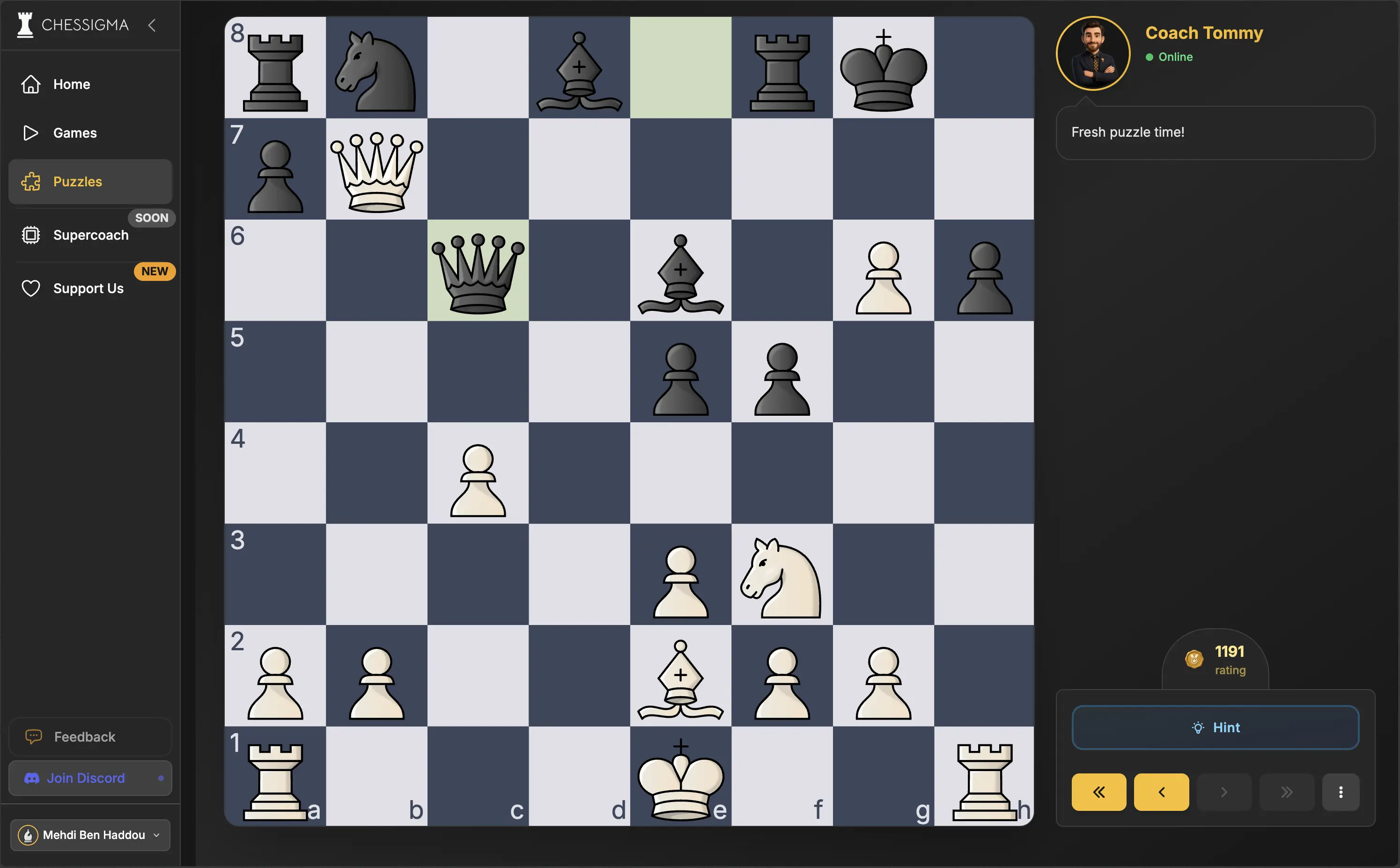
The best chess puzzles for beginners are free, matched to your level, and focused on the five tactical patterns that decide 90% of beginner games. Puzzles first, then one opening: start solving free chess puzzles that actually build pattern recognition and watch your rating climb.
Why Puzzles Come Before Opening Theory (Every Time)
Every chess forum is full of beginners asking which opening to learn first. The honest answer is that one opening per side is plenty at this stage, and it is not the thing holding your rating down. Below 1200, games aren't decided by opening theory. They're decided by who hangs a piece first. Tactical pattern recognition is the single highest-ROI skill you can build as a beginner, and puzzles are the fastest way to build it.
Think about it: you can memorize 15 moves of the Najdorf Sicilian, but if you miss a knight fork on move 16, none of that preparation matters. Puzzles train the part of your brain that spots forks, pins, and hanging pieces in real time. That skill transfers to every single game you play, regardless of opening. So pick one opening for White and one for Black, drill them until they are automatic, and spend the time you save right here. A repertoire is maintenance. Tactics are survival.
What Difficulty Should Beginners Start At?
Every chess puzzle has an Elo rating, just like players do. A 600-rated puzzle is a one-move checkmate that most people spot in seconds. A 1400-rated puzzle involves a three-move combination with a quiet intermediate move. As a beginner, start in the 800-1000 range. You should be solving about 60-70% of puzzles correctly - hard enough to learn, easy enough to not rage-quit.
Starting too hard is the #1 reason beginners quit puzzle training. If you're failing 80% of puzzles, you're not learning patterns - you're just guessing and getting frustrated. Starting too easy wastes time. You need the sweet spot where puzzles stretch your vision without breaking it. Chessigma's Elo system handles this automatically: solve a puzzle and your rating goes up, fail and it goes down. The free chess puzzles adjust to match your actual level after just a few attempts.
The 5 Tactical Patterns Every Beginner Must Know
These five patterns show up in almost every beginner puzzle. Learn to spot them and you'll solve most puzzles under 1200 Elo. These are the building blocks - even grandmasters still use these exact same tactics, just in more complex positions.
- Fork. One piece attacks two enemy pieces at once. Knights are the classic fork piece - they jump over everything and attack in weird directions beginners don't expect. If you learn one pattern first, make it this one.
- Pin. A piece is "stuck" because moving it would expose a more valuable piece behind it. Bishops and rooks love creating pins. Beginners miss these constantly because they only look at the piece, not what's behind it.
- Skewer. The reverse of a pin - you attack a valuable piece, forcing it to move, and capture the piece behind it. Same geometry as a pin, different direction. Once you see pins, skewers click fast.
- Discovered attack. You move one piece and "discover" an attack from a piece behind it. Devastating because your opponent has to deal with two threats at once. Beginners rarely see these coming.
- Back-rank mate. The king is trapped on the back row by its own pawns, and a rook or queen delivers checkmate. This is how most beginner games end. Learn it, and you'll both deliver it and avoid falling for it.
How Many Chess Puzzles Should Beginners Do Per Day?
10-15 puzzles daily beats 100 puzzles once a week. Every time. Your brain consolidates patterns overnight through spaced repetition - 15 puzzles today plus 15 tomorrow gives you two learning cycles. A hundred puzzles in one sitting gives you one, and your focus tanks after the first 20 anyway.
The key is making it a habit, not a marathon. Same time every day, even just 10 minutes. Morning coffee plus five puzzles. Lunch break plus ten puzzles. Whatever sticks. Build a streak and protect it - that's how patterns move from conscious calculation to automatic recognition. If you want structured daily practice, try solving one daily chess puzzle as your anchor habit, then add 10-15 from the unlimited pool on top.
💡 Pro tip: Set a timer for 2 minutes per puzzle. If you can't solve it, study the solution - understanding why you missed it teaches more than guessing.
Free Chess Puzzles for Kids - What Parents Should Know
Chess puzzles for kids aren't just games - they build concentration, logical thinking, and pattern recognition in ways that transfer to math and problem-solving. Kids as young as 5-6 can start with simple one-move checkmate puzzles (around 400-600 Elo). By age 8-9, most kids handle standard beginner puzzles in the 800-1000 range.
The biggest issue with most puzzle platforms for kids? Cluttered interfaces, distracting ads, and paywalls that kill momentum right when they're engaged. Chessigma's interface is clean and distraction-free - no ads, no popups, no "buy premium" interruptions. The Elo system automatically adjusts difficulty so kids never feel overwhelmed or bored. They just solve puzzles at their level, and the system grows with them.
Why Chessigma Puzzles Are Better for Beginners
Chess.com gives you 5 free puzzles per day then hits the paywall. Lichess has unlimited puzzles but the interface wasn't built with beginners in mind. Chessigma gives you unlimited puzzles, real Elo-based difficulty matching, and a clean interface - all free, no signup required to start. Your puzzles are always at the right difficulty because the system tracks your actual level, not some arbitrary "easy/medium/hard" setting that means nothing.
Start Solving Free Chess Puzzles Now
Stop guessing your level. Start solving free chess puzzles matched to your skill - no signup, no paywall, no daily limit.
Frequently Asked Questions
What chess puzzles should beginners start with?
Start with puzzles rated 800-1000 Elo that focus on single tactical themes like forks, pins, and back-rank mates. You should solve about 60-70% correctly. If you're getting most of them wrong, drop the difficulty. Chessigma's Elo system adjusts automatically so you're always at the right level.
How many chess puzzles should a beginner do per day?
10-15 puzzles daily with full concentration. Quality over quantity - your brain consolidates patterns overnight, so consistent daily practice beats marathon sessions. Spend at least one minute thinking per puzzle before moving. If you only have 5 minutes, solve 3-5 puzzles with real focus.
Are chess puzzles good for kids?
Yes. Chess puzzles build concentration, logical thinking, and pattern recognition in children. Kids as young as 5-6 can start with simple checkmate puzzles. The key is using a distraction-free platform with automatic difficulty adjustment so kids stay challenged without getting frustrated. No ads and no paywalls keep them focused.
What is puzzle Elo in chess?
Puzzle Elo is a rating system that measures both puzzle difficulty and your solving ability. Every puzzle has a rating - solve it and your Elo goes up, fail and it goes down. The system then serves puzzles matched to your current level. It's the same concept as player ratings but applied specifically to tactical puzzles.
Are free chess puzzles as good as paid ones?
Absolutely. The puzzle quality depends on the source database and the Elo matching system, not whether you paid for it. Chessigma uses the same high-quality puzzle database with real Elo ratings - unlimited, free, with no features locked behind a paywall. Paying for puzzles on other platforms gets you volume access, not better puzzles.
Do chess puzzles actually help you improve?
Yes - puzzles are the single most effective training method for beginners. They build tactical pattern recognition, which is the foundation of all chess improvement. Players who solve 10-15 puzzles daily at the right difficulty see measurable rating gains within weeks. The key is consistency and solving at your level, not grinding hundreds of random puzzles.
Keep Reading
Free Chess Puzzles with Unlimited Practice - everything about Chessigma's unlimited puzzle system, Elo tracking, and how it connects to the AI Supercoach.
Daily Chess Puzzles: The One Habit That Actually Improves Your Chess - why solving one puzzle per day with full focus beats marathon sessions every time.
How to Analyze Your Chess Games: Complete Guide - combine puzzle training with game analysis to find the exact patterns you keep missing.