

Chess AI Helper: How to Use One Without Wrecking Your Game
A chess AI helper hands you the best move but never the reason. Learn the workflow that turns free engine lines into patterns, and where the AI goes blind.
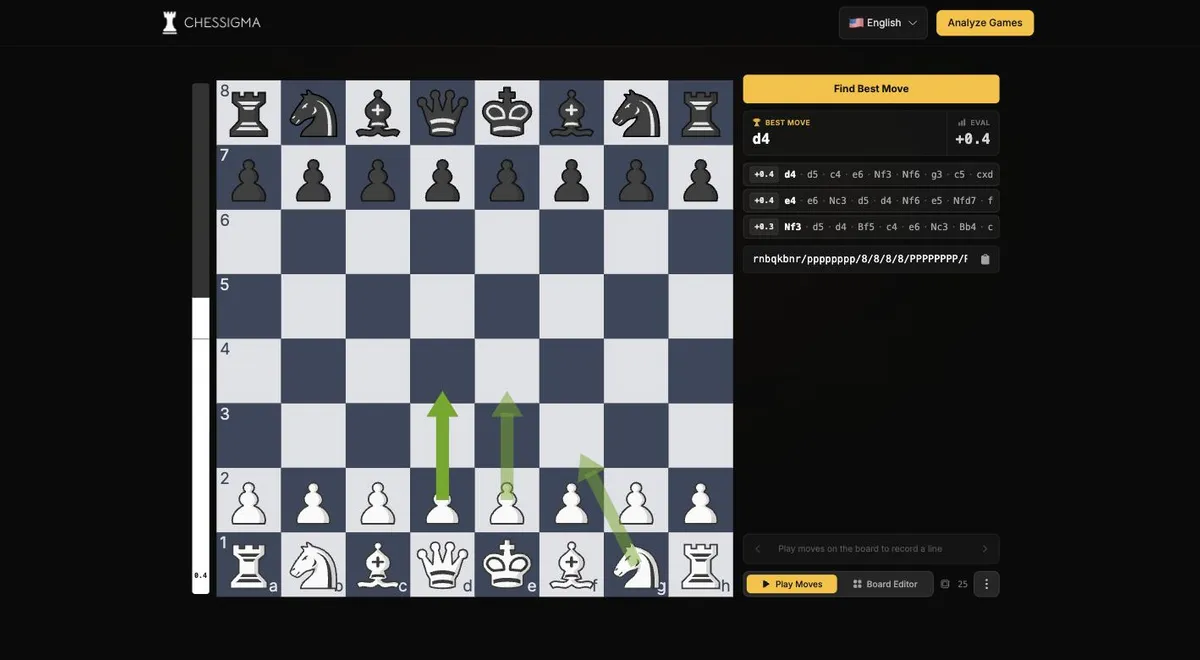
A chess AI helper will hand you the best move in any position, free, in seconds. That used to be the expensive part of chess; now it's the cheap part. The reason behind the move still costs real work, and the reason is the only part your rating remembers. This guide covers what a helper actually does, where it goes blind, and the workflow that turns its output into moves you find on your own next time.
Ask the engine before you read on
Paste any position into Chessigma's free calculator and Stockfish 17 runs right in your browser: best move, evaluation, and full engine lines. No signup, no limits.
Get the AI's next move freeWhat a chess AI helper actually does
Strip away the interface and every helper is the same machine: a chess engine that searches millions of positions and scores each one with an evaluation function. You feed it a position, it returns three things. Knowing exactly what each one is (and is not) keeps you from over-reading all of them.
| Output | What it is | What it never tells you |
|---|---|---|
| Best move | The strongest move found at the current depth, e.g. Nxd4 | What the move accomplishes, or which plan it serves |
| Evaluation | A score in pawns (+1.2) or a forced mate (M6) | How hard the position is for a human to actually play |
| Engine line | The expected continuation if both sides play the top choice | Which single idea in the line is the one worth remembering |
| Depth | How many half-moves ahead the search has settled | Whether that depth is enough for this specific position |
Notice the pattern in the right column. Every gap is the same gap: the helper computes, it does not teach. That gap is not a bug you can wait out with a stronger engine. It is the design.
The move is free. The why is the product.
An engine has no concepts. It does not know what an outpost, a bad bishop, or a weak back rank is. It searches a tree of moves and scores leaf positions with a neural network; the "best move" is simply the top of the highest-scoring branch. So when it outputs Bxf7+, there is no explanation sitting behind the number waiting to be unlocked. The explanation does not exist anywhere in the machine. It has to be built by you, from the line.
An engine line you cannot restate in one plain sentence is trivia. The move improves the position you pasted; the sentence improves every position like it that you will ever reach.
This is why two players can use the same free helper for a year and one of them gains 200 points while the other gains a habit. The first one interrogates the output; the second one consumes it. A newer class of tools narrows the gap by bolting an AI explanation layer on top of the engine; we compare the current options in our guide to the best chess AI tools. But even with explanations on tap, the extraction workflow below is what makes any of it stick.
A workflow that extracts the pattern, not just the move
Here is the full loop, start to finish. It takes about three minutes per position and it works with any engine-based helper.
- 1. Copy the FEN. A FEN is one line of text encoding the whole position. Every major site's analysis board exports it, and any position you set up by hand has one.
- 2. Paste it and let the engine settle. Watch the depth counter and wait until it stops climbing before you trust anything, especially in the opening.
- 3. Read the line, not just the move. The best move alone is nearly useless. The engine line is where the point of the move lives.
- 4. Name what the move accomplishes. One question, answered in words before you move on: attack, defense, trade, square, file, king safety? If you can't answer, step through the line until the point reveals itself.
- 5. Write the pattern with no notation in it. One sentence, plain nouns. The sentence transfers to your next game; Nxd4 does not.
Worked example: the free pawn that wasn't
You're White after 1. e4 e5 2. Nf3 Nc6 3. Bc4 Nd4. Black's last move looks like a beginner mistake: the knight jumped to d4 and simply stopped defending e5. You want to take the pawn. Paste the position first:
FEN to paste into the helper
r1bqkbnr/pppp1ppp/8/4p3/2BnP3/5N2/PPPP1PPP/RNBQK2R w KQkq - 4 4
Engine: 4. Nxd4 (or 4. c3)
The helper refuses the free pawn. Its top choices are quiet: trade the annoying knight or kick it. The grab you wanted to play sits far down the list with the eval flipped against White.
Your move: 4. Nxe5?
Step into the line to see why. Black replies 4...Qg5!, one queen move hitting two loose targets at once: the knight on e5 and the pawn on g2. White cannot cover both, and the greedy follow-up 5. Nxf7 Qxg2 6. Rf1 Qxe4+ 7. Be2 Nf3# ends in checkmate. This is the Blackburne Shilling Gambit, and the "free" pawn was the bait.
The pattern, written down
A pawn left hanging in the opening is usually rented, not free: the price is a forcing reply. Before grabbing, find the opponent's most forcing response, checks and queen moves first.
That sentence is the actual product of the session. The eval and the refutation line were just the raw material. Skip step 5 and you have learned one trap; do step 5 and you have learned every position where a gift comes with a forcing string attached.
How to read the eval without fooling yourself
The evaluation number is the most misread part of any helper, because it answers a question nobody asked: "who stands better if both sides play like engines from here?" You are not playing an engine, and neither is your opponent. Translate accordingly.
| The number | The tempting read | The better read |
|---|---|---|
| +1.2 | "White is winning" | White has a serious edge if the next thirty moves are accurate. At club level, an edge this size changes hands routinely. |
| 0.00 | "Dead draw" | Balanced, not simple. It covers everything from bare kings to a razor-sharp mess where one slip loses on the spot. |
| -0.4 | "My opening failed" | Well inside the normal cost of a playable opening. Most sound setups for Black concede something in this range. |
| M6 | "I can relax" | Forced only if every move is exact. Engines show the fastest mate, not the easiest one; a safe slower win often beats the flashy line the helper prints. |
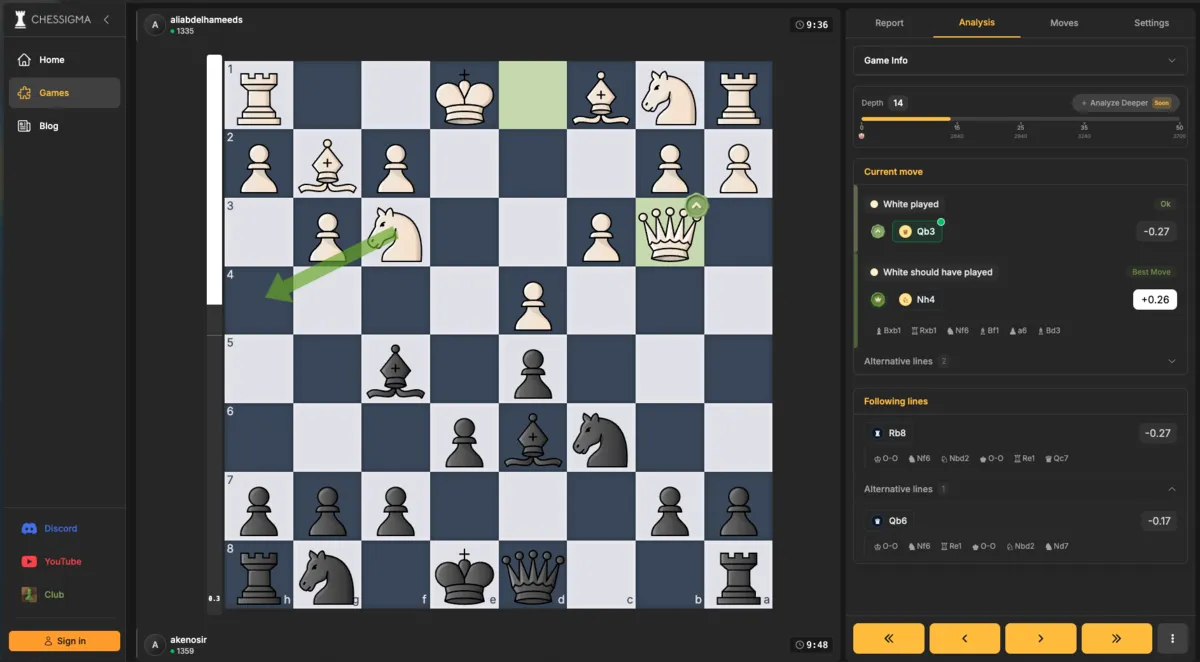
A full-game report makes this translation easier because you see the eval as a graph over the whole game instead of one number in isolation: the swings mark exactly where the real decisions happened.
Where the helper goes blind
Trusting an engine everywhere is as costly as trusting it nowhere. The blind spots are specific and predictable, so you can route around them.
- No explanations, ever. The output is a move, a number, and a line. Every "why" is your job or a coach's job.
- Opening judgment at low depth. A browser engine early in its search evaluates openings by short-term tactics. It can be lukewarm on main-line theory and enthusiastic about a move that leads nowhere. Depth first, verdict second.
- The horizon. Whatever lies past the last calculated move does not exist for the engine. Slow squeezes and fortress positions are the classic victims of a shallow search.
- Perfect-play assumption. The eval prices in flawless defense. A position scored as "holdable" can be practically lost for a tired human with two minutes on the clock.
- No model of you. The helper recommends the objectively strongest move even when a simpler, slightly worse move is the one you would actually convert.
Helper or cheat: where the line actually sits
The line is not fuzzy, and it is not about which tool you use. It is about when. Engine input while a rated game is in progress is cheating on every major site, and accounts get closed for it. The same engine, opened after the result is posted, is nothing but a study tool.
- After the game: paste your critical positions, hunt the why, extract patterns. This is training.
- During a casual game vs a bot or a friend who agreed: a legitimate way to learn in real time.
- During any rated game: cheating, full stop, whatever the tool is called.
There is more nuance to the ethics than one section can hold (analysis during correspondence chess, opening prep, mid-tournament review), and we take the whole question apart in is using chess AI cheating.
Get the why, not just the move
Supercoach, Chessigma's AI coach, analyzes 12 months of your games and explains the patterns behind your mistakes in plain language. The extraction step, done for you, across your whole history.
Meet your AI coachFrequently Asked Questions
Is there a free chess AI helper?
Yes. Chessigma's next-move calculator runs Stockfish 17 directly in your browser: paste a FEN and you get the best move, the evaluation, and full engine lines. No signup and no position limit, because the engine runs on your device instead of a server.
How does a chess AI helper choose the best move?
It searches the tree of possible moves and scores the resulting positions with an evaluation function; modern Stockfish uses a neural network (NNUE) for that scoring. The move at the top of the highest-scoring line is reported as best. The output is superhuman, but it is a number and a move list, not an explanation.
Do chess AI helpers explain why a move is good?
Raw engines do not. You get the move, the eval, and the continuation; the interpretation is left entirely to you. That is the skill worth building: play through the line and name what the move accomplishes. Tools with an AI coach layer add plain-language explanations on top of the engine output.
Is using a chess AI helper cheating?
During a rated game, yes. Every major chess site bans engine assistance while a game is in progress and closes accounts over it. Between games it is standard practice, and it is how strong players have studied for as long as engines have existed. Analyze after, never during.
Why does the helper suggest strange moves in the opening?
At low depth an engine judges the opening by short-term tactics rather than long-term plans, so it can shrug at main-line theory and warm to moves that fizzle out ten moves later. Let the depth counter climb before trusting an opening verdict, and keep established theory next to the eval as a second reference.