Free Chess Game Analyzer. Review Any Game Instantly
Hit the paywall one too many times? Chessigma is a free chess analyzer powered by Stockfish, the strongest chess engine online. Paste a game, get a full report. Every move graded. Unlimited games. No account, no credit card, no catch.
What Your Chess Analysis Report Shows You
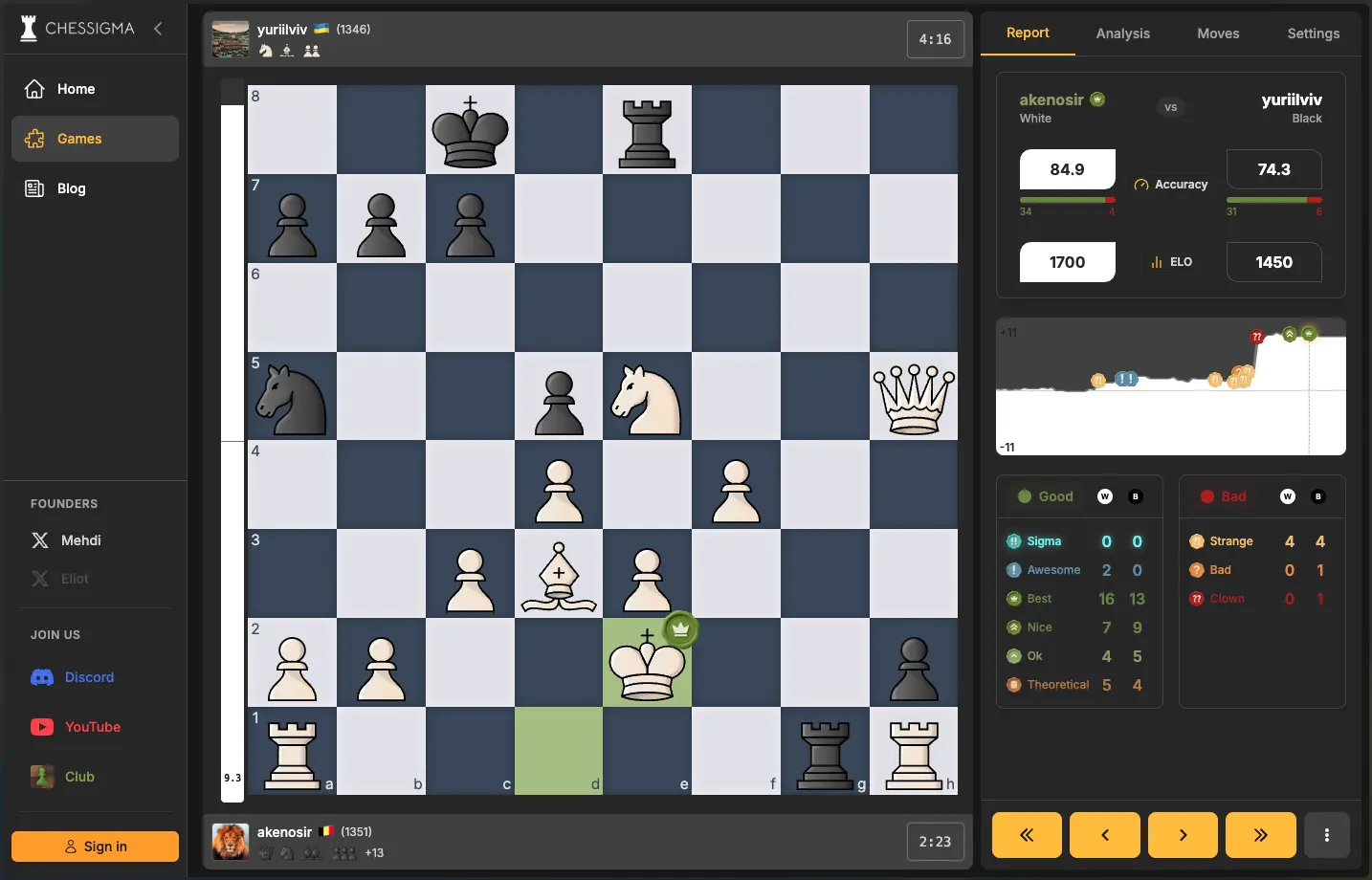
A chess game report is a move-by-move breakdown of your game scored by a chess engine, showing exactly where you played well, where you went wrong, and what you should have done instead. After Chessigma runs your game through Stockfish, you get a detailed analysis report with several key metrics that tell the full story of your performance.
Move grades classify every move into one of six categories: Brilliant, Great, Good, Inaccuracy, Mistake, and Blunder. These aren't arbitrary labels. Each grade reflects how much evaluation the move gained or lost compared to the engine's top choice. A Brilliant move finds a non-obvious winning continuation that even strong players miss, while a Blunder throws away material or a decisive advantage.
Centipawn loss measures how many hundredths of a pawn each move costs you versus the optimal play. A move with zero centipawn loss is engine-perfect. Consistent centipawn loss above 30 across a game means you're regularly leaving value on the board and need to sharpen your calculation.
Accuracy score distills your entire game into a single percentage. It weighs all your moves against the engine's evaluation, giving you a quick read on how well you played overall. Scores above 90% are strong even at club level. Comparing accuracy across games reveals whether you're actually improving or just winning against weaker opponents.
Critical moments flag the specific positions where the game swung. A drawn position that turned losing, or a slight edge that became a decisive attack. These are the positions worth studying deeply because they represent the turning points where your decisions had the biggest impact on the outcome.
Understanding these metrics turns a chess move analyzer from a passive scorecard into an active improvement tool. Don't just glance at the result. Learn to read the data and you'll know exactly what to work on.
How to Actually Use Chess Engine Analysis to Improve
To analyze a chess game, import it into a chess engine and review the analysis report starting with your biggest mistakes, not move one. For each error, compare your move to the engine's suggestion and understand the tactical or positional idea you missed. This focused review builds real improvement faster than clicking through every move.
Most players run an analysis and scroll through the whole game move by move. That's a waste of time. Your chess engine analysis is most valuable when you target the moments that actually decided the game.
Start with blunders and mistakes. Open the game report, jump to the first red-flagged move, and ask yourself: what did I think I was doing here? Then look at the engine's best move. The gap between your idea and the engine's idea is where your chess education lives.
After reviewing individual mistakes, zoom out. Look at your centipawn loss graph over the whole game. If it spikes in the middlegame, you might have calculation issues. If it gradually climbs in the endgame, your technique needs work. The pattern across multiple games matters more than any single move.
The best way to use a chess analysis engine is to analyze in batches. Play three to five games, then review them back-to-back. You'll start noticing recurring themes: the same types of tactical patterns you miss, the same structural weaknesses you create, the same endgame mistakes you repeat. That's your training plan writing itself.
Keep a mental note of your top two or three recurring mistakes. Then use targeted practice like tactics puzzles, endgame drills, or opening study to address those specific weaknesses. Come back to the analyzer after a week and check if those patterns are fading.
For a deeper walkthrough of this process, read our complete guide to analyzing chess games. If you're curious about the technical side, how Stockfish evaluates positions and how our grading system works, see how Chessigma analysis works under the hood.
Import From Chess.com, Lichess, or PGN
Three ways to get your games into the analyzer. Pick whichever fits your workflow.
Chess.com import. Enter your Chess.com username and Chessigma pulls your recent games automatically. Select any game from the list and analyze it. Works as a full chess.com analysis board alternative without the paywall.
Lichess import. Same process. Enter your Lichess username, browse your game history, and pick the game you want to review. If you use Lichess as your main platform, this gives you deeper lichess analysis with Stockfish running locally at full depth.
PGN upload. Have a PGN file from a tournament, a coaching session, or another source? Paste the PGN text directly into the analyzer. Chess pgn analysis works with any standard PGN format, including games with annotations and multiple variations. PGN analysis is the most flexible option for games from any source.
Chessigma vs Chess.com Analysis: What's the Difference?
Both tools run Stockfish underneath. The chess engine is the same. What's different is everything around it.
Chess.com locks full game review behind its Diamond subscription. You get one free analysis per day (or zero on some plans), and the depth is limited. On Chessigma, every game review runs at full depth with no daily limits. That's the core difference and the reason most players look for a chess.com alternative.
Accuracy scores may differ slightly between the two. Chess.com uses a proprietary accuracy formula. Chessigma uses a centipawn-based calculation with Stockfish's raw evaluation. Neither is objectively "right." They just weight moves differently. The move grades (Brilliant, Blunder, etc.) are based on the same engine output but the thresholds vary.
Your Chess.com account won't get banned for using Chessigma. We don't interact with your account at all. We just fetch publicly available game data through their API. No automation, no cheating, no risk.
If you're paying for Chess.com Diamond just for game analysis, you can probably cancel. The analysis is the same engine. The game report gives you the same insights. Except here it's free.
Frequently Asked Questions
Is the chess analyzer really free?
Yes. Chessigma runs Stockfish directly in your browser using WebAssembly. There are no server costs per analysis, so there's no reason to charge. You get unlimited game reviews with full-depth engine analysis, move grades, and accuracy scores. No account required, no credit card, no trial period.
How accurate is the chess engine analysis?
Chessigma uses Stockfish 16, the strongest open-source chess engine in the world, rated above 3500 Elo. The analysis runs at high depth locally in your browser. Results are comparable to Chess.com and Lichess analysis since all three platforms use Stockfish as the underlying engine.
Can I analyze a PGN file?
Yes. Paste any standard PGN text into the analyzer and get a full game report. Chess pgn analysis supports games with annotations, variations, and comments. Works with PGNs from tournaments, coaching sessions, or any chess platform.
Does it work with Chess.com and Lichess games?
Yes. Enter your Chess.com or Lichess username and browse your recent games directly in Chessigma. Select any game to get a complete analysis report with move grades and engine lines. No need to manually export PGN files. We pull your games automatically through the public API.
Will my Chess.com account get banned for using this?
No. Chessigma only accesses publicly available game data through Chess.com's official API. We don't automate gameplay, access your account credentials, or do anything that violates Chess.com's terms of service. Your account is completely safe.
What is centipawn loss in chess?
Centipawn loss measures the accuracy of each move in hundredths of a pawn. A centipawn loss of zero means you played the engine's top choice. Higher values indicate weaker moves. Average centipawn loss across a game gives you a reliable measure of your overall playing strength.
What does a brilliant move mean in chess?
A brilliant move is a strong, non-obvious move that significantly improves your position, typically a sacrifice or counterintuitive play that the engine confirms as best or near-best. In Chessigma's analysis, brilliant moves are the highest grade a move can receive, flagging exceptional play most players would miss.
How is this different from the Chess.com analysis board?
Both use Stockfish. The main difference: Chess.com limits free users to one game review per day and locks deeper analysis behind a paid subscription. Chessigma gives you unlimited full-depth analysis for free. Accuracy formulas differ slightly, but the engine evaluations and move grades are equivalent.
How it works


Import From Chess.com, Lichess or PGN Files
Enter your username to browse all your recent games. Or paste a PGN file to analyze any game.

Review Your Mistakes
Each move is graded from brilliant to blunder. Jump straight to the moves that cost you the game.

Learn From Your Mistakes
For every mistake, see what you should have played instead. Understand why and improve for next time.
Built by Chess Players
We're two engineers from Belgium with backgrounds in the biggest tech companies who wanted better Chess tools.


We know how to ship great products, fast.